


Easter Sunday falls on the last day of March this year, and spring is already making its presence felt—asparagus poking through the soil, lamb arriving at the butcher counter, the first sweet peas of the season brightening up market stalls. It is one of the most anticipated meals of the year, and yet, far too often, the cook spends the entire day hunched over the stove while everyone else hides eggs in the garden. That does not have to be the story.
These 21 Easter dinner ideas are built around one core principle: maximum impact, minimum last-minute effort. Whether you are feeding a crowd of twelve around a long table or hosting a quiet gathering of four, every idea here is designed so that most—if not all—of the work happens the day before, or simply takes care of itself in the oven. Roasted legs of lamb that perfume the house with rosemary and garlic while you pour yourself a glass of wine. Sheet-pan sides that come together in thirty minutes flat. Desserts that set overnight in the refrigerator without asking anything of you on the day. Pull on your apron once—the night before—and spend Easter Sunday exactly where you belong: at the table with the people you love.
The rule that changes everything: cook ahead or cook hands-off
The secret to a stress-free Easter dinner isn't a single recipe; it's a strategy. Every dish in this collection falls into one of two categories: make-ahead, meaning it is better the next day anyway, or hands-off, meaning the oven or slow cooker does the heavy lifting while you are otherwise occupied. Understanding that distinction before you start planning your menu is what separates a frantic Easter cook from a relaxed one.
Braises, for instance, are the Easter cook's closest ally. A slow-cooked shoulder of lamb with white beans and preserved lemon needs four to five hours of gentle heat, but it requires perhaps twenty minutes of active work. You can start it mid-morning, let it simmer away while the children are outside, and arrive at the table with something that tastes as though it took the entire week to prepare. The collagen in the shoulder has had time to break down, the braising liquid has concentrated into something almost wine-dark and glossy, and the meat falls apart at the suggestion of a fork.
21 ideas for a relaxed Easter table
1. Slow-roasted leg of lamb with garlic and rosemary
The classic for a reason. A bone-in leg, studded with slivers of garlic and fresh rosemary, roasted low and slow for three to four hours until the exterior is deeply bronzed and the interior remains faintly pink. Season it the night before and leave it uncovered in the refrigerator so the skin dries out and crisps beautifully. All you need to do on Easter morning is pull it from the cold and let it come to room temperature before it goes into the oven.
2. Braised lamb shoulder with white beans
Even more forgiving than a leg roast, the shoulder rewards low temperatures and long cooking times. Brown the meat deeply in a wide Dutch oven, add white wine, chicken stock, canned tomatoes, and a handful of dried white beans soaked overnight. Cover tightly and slide it into a 150°C (300°F) oven for five hours. The beans absorb the braising liquid and become something extraordinary—silky, savory, faintly smoky from the browned meat.
3. Honey-glazed ham
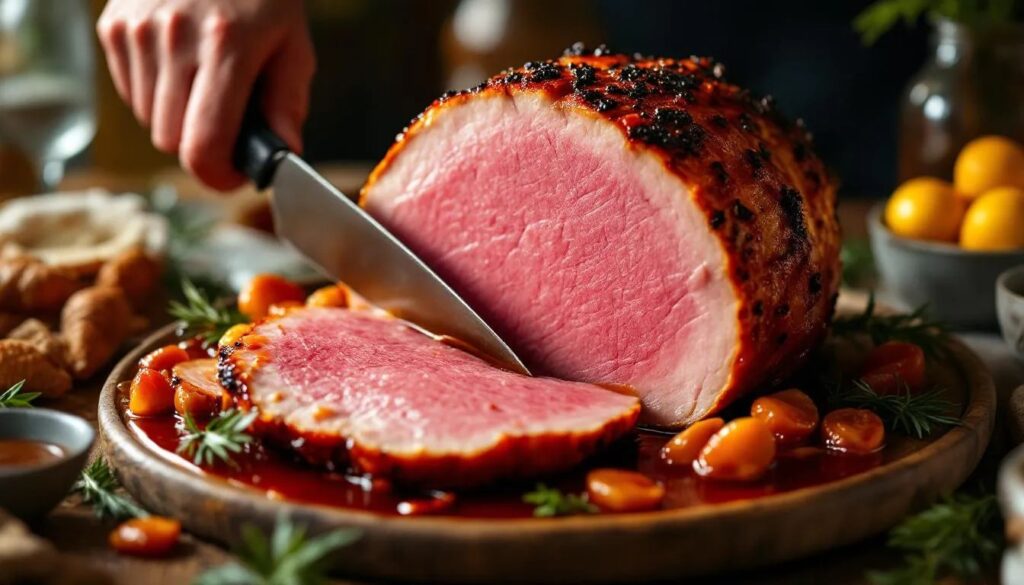
A fully cooked bone-in ham is among the most hospitable things you can put on a table. Score the fat in a diamond pattern, stud each intersection with a clove, and paint the whole surface with a glaze of honey, Dijon mustard, orange zest, and a splash of apple cider vinegar. It goes into a 175°C (350°F) oven for roughly ninety minutes, basting every twenty minutes. The glaze caramelizes into something lacquered and fragrant. It serves beautifully at room temperature, which removes all timing pressure entirely.
4. One-pan spring chicken with lemon and peas
Bone-in, skin-on chicken thighs scattered across a sheet pan with halved spring onions, a generous handful of fresh peas, sliced lemon, and a drizzle of olive oil. Into a hot oven—200°C (400°F)—for forty-five minutes. The chicken skin renders and crisps, the lemon edges char slightly and sweeten, the peas just catch a little color. It reads as celebratory without demanding anything beyond a single sheet pan and a hot oven.
5. Baked salmon en papillote with asparagus
Few spring combinations are more harmonious than salmon and asparagus. A fillet of salmon placed on a generous sheet of parchment with a bundle of trimmed asparagus spears, a few slices of lemon, a sprig of dill, and a splash of white wine. Fold the parchment into a sealed parcel and bake at 190°C (375°F) for eighteen to twenty minutes. Everything steams in its own aromatic pocket, and each guest receives their own parcel to open at the table—a small, theatrical moment that costs nothing extra.
6. Slow cooker pulled lamb tacos
A genuinely crowd-pleasing move for a younger crowd or an informal Easter gathering. Lamb shoulder, generously seasoned with cumin, smoked paprika, coriander, and dried chili, goes into the slow cooker the night before on low heat. By morning, the meat shreds effortlessly. Set out warm flour tortillas, pickled red onion, sliced avocado, and a sharp herb crema—guests build their own, which removes all plating pressure from the cook entirely.
7. Spring vegetable frittata
For a lighter Easter table, or for a crowd that includes vegetarians, a deep frittata built with asparagus, spring onion, fresh peas, ricotta, and lemon zest holds beautifully at room temperature. Cook it in a cast-iron skillet, finish it under the broiler until the top is set and faintly golden, and serve it in wedges directly from the pan. It can be baked the morning of and left to rest without any loss of quality.
8. Crown roast of pork
Visually dramatic but technically straightforward, a crown roast is two racks of pork tied into a circle and filled with a savory stuffing of apple, fennel, and sage. Ask your butcher to prepare the crown for you—the construction is the hard part, and they will do it willingly. Season it the night before. The roast goes into the oven two hours before dinner and announces its readiness with a fragrance that fills the entire house.
9. Ricotta and spinach stuffed shells
Assemble these completely the night before—jumbo pasta shells filled with a mixture of whole-milk ricotta, blanched spinach, Parmesan, egg, and nutmeg, arranged in a baking dish over a layer of tomato sauce and covered tightly with foil. On Easter, slide the cold dish straight into the oven. The pasta finishes cooking in the sauce while the cheese filling sets and the top bubbles. Forty-five minutes, no attention required.
10. Whole roasted cauliflower with harissa butter
A striking centerpiece for a vegetarian Easter table. The entire cauliflower, leaves intact, is rubbed all over with a mixture of softened butter, harissa, garlic, and lemon juice. Roast it at 200°C (400°F) for an hour and fifteen minutes, basting once or twice. The outer leaves blacken slightly and taste almost meaty. The interior becomes tender and sweet, absorbing all the spiced butter as it roasts.
11. Make-ahead deviled eggs
No Easter table in the United States is truly complete without them. Hard-boil two dozen eggs the day before, peel them, and store them in cold water overnight. Fill and garnish them the morning of—the whole process takes twenty minutes. The filling, made with the yolks, mayonnaise, Dijon mustard, a touch of white wine vinegar, and sweet paprika, can itself be piped ahead and refrigerated covered.
12. Roasted leg of lamb with za'atar and pomegranate
A Middle Eastern-inflected take on the Easter classic. The leg is coated in a thick paste of za'atar, olive oil, garlic, and lemon juice, then left to marinate overnight. It roasts at moderate heat and finishes with a shower of fresh pomegranate seeds and chopped flat-leaf parsley. The contrast between the herb-crusted exterior, the faintly pink interior, and the bright acidity of pomegranate is striking.
13. Sheet pan gnocchi with spring vegetables
Store-bought gnocchi scattered across a sheet pan with halved cherry tomatoes, asparagus tips, red onion, and a drizzle of olive oil—roasted at 220°C (425°F) for twenty-five minutes until the gnocchi develops a lightly crisped exterior and the vegetables soften and char at the edges. Finish with torn fresh basil and a grating of Parmesan. A side dish that becomes a meal, or a meal that works as a generous side.
14. Slow-roasted salmon with cucumber yogurt
A whole side of salmon, seasoned simply with salt, olive oil, and lemon zest, roasted at a very low 120°C (250°F) for thirty-five to forty minutes. At that temperature, the fat renders gently, and the flesh remains silky and almost custardy. The cucumber yogurt sauce—grated cucumber, thick Greek yogurt, garlic, dill, lemon—takes five minutes to assemble and can be made entirely the day before.
15. Provençal-style lamb stew with olives and tomatoes
This is a stew that improves dramatically overnight. Chunks of lamb shoulder are browned, then slowly braised with white wine, canned tomatoes, Kalamata olives, capers, thyme, and bay leaf. Make it on Saturday. Refrigerate overnight. On Easter Sunday, lift the solidified fat from the surface, reheat gently, and serve over egg noodles or with crusty bread. The depth of flavor after a night's rest is something the freshly made version simply cannot match.
16. Carrot soup with ginger and coconut
A smooth, vibrant soup that works beautifully as a first course and can be made entirely the day before. Roasted carrots, blended with ginger, garlic, coconut milk, and a squeeze of lime. The roasting concentrates the natural sweetness of spring carrots. Reheat gently before serving and finish with a drizzle of coconut cream and a few toasted sesame seeds. It is light enough not to overwhelm the courses that follow.
17. Easter bread (tsoureki or hot cross buns)
Whether you follow the Greek tradition of tsoureki—a richly spiced enriched bread braided and topped with a red egg—or the British custom of hot cross buns, both benefit from being made the day before. The flavors develop overnight, the crumb settles, and on Easter morning you have bread that needs nothing beyond a brief warm in a low oven and a generous spreading of good butter.
18. Quiche lorraine (or spring vegetable quiche)
Quiche is the original make-ahead Easter dish; it was invented for exactly this purpose. Blind-bake the crust the day before, fill it with a custard of eggs, cream, Gruyère, and either lardons or spring vegetables, and bake it on Saturday evening. Serve it on Easter at room temperature, which is, in fact, how quiche tastes best—the custard is set but still trembling faintly, the crust remains crisp.
19. Roasted spring vegetable platter with green goddess dressing
A composed vegetable platter that earns its place as a centerpiece rather than an afterthought. Asparagus, spring onions, radishes, snap peas, and young carrots, simply dressed and either roasted or served raw. The green goddess dressing—blended with avocado, herbs, lemon, and a spoonful of mayonnaise—can be made two days ahead and improves with time. It turns a side dish into something that guests genuinely reach for.
20. Lemon posset
Three ingredients: cream, sugar, lemon juice. Heated together until thickened, poured into small glasses or ramekins, refrigerated overnight. That is the entirety of the recipe. The result is a dessert of extraordinary elegance—silky, intensely lemon-flavored, cool, and trembling. Serve with a small shortbread biscuit and a few fresh raspberries, the first of spring. Nothing on the Easter table requires less work or earns more praise.
21. Chocolate tart with sea salt
The Easter dessert that requires zero baking if you use a no-bake filling: a dark chocolate ganache—made by pouring hot cream over chopped dark chocolate, stirring until smooth, and seasoning with a pinch of flaky sea salt—poured into a pre-baked or store-bought tart shell. Refrigerate overnight. The ganache sets to a dense, fudgy consistency that cuts cleanly and tastes deeply of chocolate. A scatter of flaky sea salt on top and nothing more.
Building your Easter menu
The strongest Easter menus pair one hands-off centerpiece with two or three sides that require almost no active cooking on the day. A slow-roasted leg of lamb as the anchor, a make-ahead carrot soup to start, roasted sheet-pan vegetables alongside, and a lemon posset waiting in the refrigerator for dessert—that is a meal that would satisfy any table, and it demands perhaps forty minutes of active kitchen time on Easter Sunday itself.
Consider temperature variety, too. A cold first course, a hot centerpiece, a platter that works beautifully at room temperature—distributing the oven schedule across dishes means nothing is competing for the same rack at the same moment, and the cook isn't forced to choose between the lamb and the gratin in those critical last fifteen minutes before serving.
Shopping for an easy Easter dinner
Order your lamb from the butcher at least a week ahead; it is the most in-demand cut of the Easter season, and availability tightens sharply in the final days before the holiday. If you are planning a bone-in leg for eight or more people, confirm the weight with your butcher and ask them to confirm roasting time at your intended temperature: a 2.5 kg leg roasted at 160°C (325°F) will take approximately 2 hours and 30 minutes to reach a core temperature of 60°C (140°F) for medium-rare.
Asparagus is at its absolute best right now; look for tight, firm tips and avoid spears that have begun to flower or separate at the top. Spring peas, if you can find them fresh rather than frozen, are worth the extra effort of shelling; the sweetness of a just-shelled pea has no frozen equivalent. Radishes, spring onions, and young carrots are all at peak flavor and require almost no preparation beyond a rinse and a trim.
The evening before is where dinner is made
Saturday evening is the real secret to a relaxed Easter Sunday. Use it deliberately. Marinate the lamb. Make the soup. Assemble the quiche or the stuffed shells. Prepare the posset or the chocolate ganache. Lay the table, polish the glasses, chill the wine. A focused two-hour session on Saturday evening means that on Easter morning, the only task between you and a glass of something cold is sliding a pan into a preheated oven.
The meal doesn't need to be complicated to feel considered. Guests remember whether the table felt unhurried, whether the food arrived warm and properly seasoned, and whether the cook was sitting with them rather than disappearing into the kitchen every fifteen minutes. These twenty-one ideas exist to make that possible.
Frequently asked questions
How far in advance can I marinate a leg of lamb?
A leg of lamb can be marinated for up to 48 hours in the refrigerator, loosely covered. Longer than that, and the acid in marinades containing lemon juice or wine can begin to affect the texture of the exterior meat, making it slightly chalky. A simple dry rub of garlic, rosemary, olive oil, salt, and pepper applied 24 hours ahead is both safe and highly effective; the salt penetrates the muscle fibers overnight, seasoning the meat from within.
Can I roast a leg of lamb and a ham in the same oven?
Yes, though you will need to manage temperatures carefully since the two cuts prefer slightly different heat levels. A practical compromise is to roast the lamb at 160°C (325°F)—a touch lower than ideal for the ham, but the ham will accommodate this without issue and simply require slightly longer in the oven. Allow extra resting time for the lamb once it comes out, as resting at lower oven temperatures sometimes means a shorter carryover cook. Use a meat thermometer on both cuts rather than relying on timing alone.
What are the best make-ahead Easter side dishes?
Dishes that actively improve overnight include: braised white beans, gratins, stuffed pasta, roasted vegetable soups, and anything pickled. Dishes that hold well at room temperature without loss of quality include: frittata, quiche, roasted vegetable platters, grain salads, and most composed salads dressed with vinaigrette rather than mayonnaise. The sides to avoid making too far ahead are anything meant to be served crisp; roasted potatoes and sheet-pan gnocchi, for instance, are best made fresh on the day.
How much meat should I plan per person for an Easter dinner?
For a bone-in leg of lamb, plan for approximately 350–400 g (12–14 oz) per person; bone-in cuts lose significant weight to the bone itself. For a boneless shoulder, 250–300 g (9–11 oz) per person is generous. For a bone-in ham, 300–350 g (10–12 oz) per person is appropriate if it is the sole protein, slightly less if you are serving multiple courses. When in doubt, buy more: cold lamb makes extraordinary sandwiches, and leftover ham disappears faster than you expect.
What wines pair well with a traditional Easter lamb dinner?
Lamb's savory, mineral character calls for wines with structure and enough acidity to cut through the richness of the fat. A Côtes du Rhône or Gigondas based on Grenache and Syrah is a natural match; the herbal, garrigue notes in the wine echo the rosemary and thyme typically used to season the meat. For something more restrained, a Pinot Noir from Oregon or Burgundy works particularly well with lighter preparations. If your guests prefer white wine, a structured, aged white Rhône—Marsanne or Roussanne—has the weight to hold up against roasted lamb without overwhelming it.