

March ends, the kitchen heats up, and the last thing anyone wants is to turn on the oven. Spring arrives with its first strawberries, its cold-kissed rhubarb, its fragrant citrus hanging on a little longer before summer takes over — and all of it begs to be eaten cool, clean, and without fuss. No-bake desserts are not a compromise. They are a decision: a deliberate choice to let time and cold do the work that heat usually handles, and to trust that a well-set cream or a properly chilled tart can be just as precise and just as satisfying as anything that comes out of an oven.
This collection gathers 22 spring desserts built entirely around the refrigerator. Some set overnight. Some are ready in two hours. Several require nothing more than a bowl, a whisk, and a crust made from crushed biscuits and melted butter. All of them lean into the season: strawberries at their first blush of sweetness, lemon curd that cuts through rich cream, fresh herbs that perfume a mousse without overpowering it. The techniques vary — chilling, whipping, layering, folding — but the logic is the same: build something cold, build it well, and let the fridge finish the job.
| Preparation | 15–30 min per recipe |
| Setting time | 2 hours to overnight |
| Serves | 6–8 per recipe (varies) |
| Difficulty | Easy to Medium |
| Cost | $ / $$ |
| Season | Strawberries, rhubarb, lemon, lime, passion fruit, fresh mint, raspberries |
Suitable for: Vegetarian · Several options Gluten-Free · Several options No-Bake Vegan
1. Strawberry icebox cake
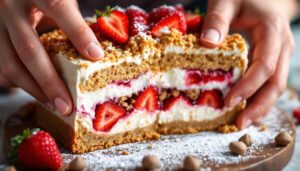
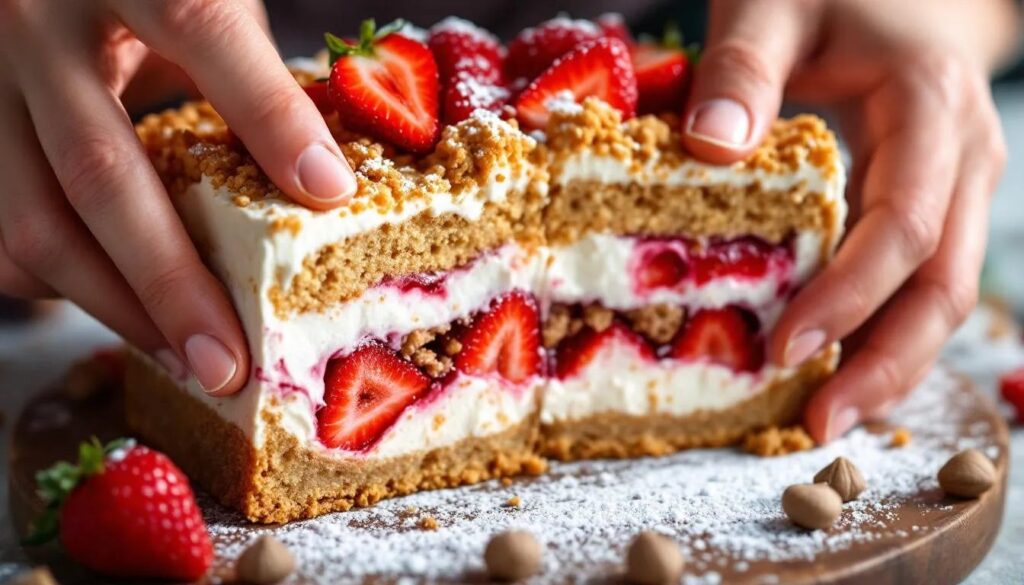
Layer after layer of whipped cream and thin wafer cookies, pressed into a loaf pan and left in the fridge overnight. The cookies absorb the cream slowly, softening into something that slices like a cake but tastes like a cloud. Use the first strawberries of the season — small, fragrant, slightly tart — sliced thin and pressed between each layer. The fruit releases a faint juice that stains the cream pink at the edges. Chill for at least 8 hours, preferably 12. The longer it sits, the more the layers become one.
2. Lemon posset with shortbread crumble
Three ingredients: heavy cream, sugar, lemon juice. That is the entirety of a posset. The acid in the lemon causes the cream to set without any gelatin, any eggs, any intervention — a chemical reaction disguised as a dessert. Bring the cream and sugar to a gentle simmer for 3 minutes, stir in the lemon juice, pour into glasses, and refrigerate for 2–3 hours. The result is silky, slightly trembling, with a citrus sharpness that cuts through the fat cleanly. Crumble store-bought shortbread over the top just before serving.
3. Mango lime cheesecake (no-bake)
The base is digestive biscuits blitzed with melted butter and pressed into a springform pan. The filling is cream cheese, whipped cream, lime zest, and lime juice, folded together until smooth and airy. Pour the mango purée — made from two ripe mangoes blended with a spoonful of sugar — over the set cream cheese layer for the final hour of chilling. It bleeds slightly into the white beneath it where the edges meet, which is not a flaw. Set for a minimum of 4 hours; overnight gives cleaner slices.
4. Raspberry fool
A fool is the simplest thing in British dessert cookery: crushed fruit folded into whipped cream, served cold. Use fresh or frozen raspberries. Warm half of them briefly with sugar until they collapse and release their juice, then crush the rest raw into the mix. Fold the fruit — both cooked and raw — into softly whipped cream in three loose passes, leaving visible streaks of deep pink through the white. The contrast is part of the texture, part of the point. Chill for 30 minutes before serving in deep glasses.
5. Chocolate mousse with fleur de sel
Melt good dark chocolate — 70% cacao minimum — over a bain-marie, the bowl sitting just above simmering water without touching it. Separate four eggs. Whisk the yolks into the warm melted chocolate off the heat, working quickly so they cook slightly without scrambling. Beat the whites to firm peaks and fold them in three additions into the chocolate base, using a spatula and a motion that cuts down through the center and lifts from the bottom. Spoon into ramekins. Refrigerate for 2 hours minimum. Finish with a pinch of fleur de sel pressed gently into the surface just before serving.
6. Coconut panna cotta with passion fruit
Replace the dairy in a classic panna cotta with full-fat coconut milk and a splash of coconut cream. Bloom 1.5 teaspoons of powdered gelatin in two tablespoons of cold water for five minutes, then dissolve it into the warmed coconut mixture over low heat. Pour into lightly oiled ramekins or straight-sided glasses. Chill for 4–6 hours. When set, spoon fresh passion fruit pulp directly over the top — the seeds crackle against the smooth, trembling surface and the acid cuts through the richness of the coconut with precision.
7. Strawberry tiramisu
The structure is identical to the classic: ladyfinger biscuits soaked in liquid, layered with a cream, dusted on top. The departure is spring: replace the espresso with a mix of strawberry juice and a splash of elderflower cordial, and replace the mascarpone cream's cocoa with finely grated lemon zest. Dip the biscuits briefly — no more than two seconds per side or they disintegrate — and layer them with the mascarpone and whipped cream mixture. Finish with thinly sliced fresh strawberries arranged across the surface. Rest overnight in the fridge.
8. Lime curd tart with almond crust
Grind 150 g of blanched almonds with dates and a pinch of salt until the mixture clumps when pressed between two fingers. Press it into a tart tin and refrigerate while the curd sets. Make the lime curd by whisking eggs, sugar, lime juice, and zest over a bain-marie until it thickens enough to coat the back of a spoon, then whisk in cold butter piece by piece off the heat. Pour into the chilled shell and return to the fridge for at least 3 hours. The curd sets to a soft, yielding consistency — firm enough to slice but loose enough to quiver.
9. Mint chocolate truffle bars
Line a small square tin with parchment. Make the base by combining crushed Oreos with melted butter, pressing the mixture down firmly and evenly. For the filling, whip together softened cream cheese, powdered sugar, and fresh mint — use leaves from the garden or from a pot on the windowsill, finely chopped — then spread it over the base. Melt dark chocolate with a spoonful of coconut oil for shine and pour it over the top in a smooth, even layer. Refrigerate for 3 hours until the chocolate layer snaps cleanly when cut. Slice into bars with a warm knife.
10. Rhubarb and vanilla parfait
Poach rhubarb stalks in a light syrup — water, sugar, a vanilla pod split lengthways — until they just soften but hold their shape, about 8–10 minutes at a gentle simmer. The color deepens from pale pink to a vivid coral. Let them cool completely, then layer them in glasses with vanilla whipped cream, alternating fruit and cream in three passes. Finish with a spoonful of the poaching syrup, which thickens slightly as it cools and pours like a light sauce. Chill for 1 hour before serving.
11. No-bake matcha cheesecake
The biscuit base here is made from gingersnaps — their warmth plays well against the vegetal bitterness of the matcha. Sift 2 teaspoons of ceremonial-grade matcha into the softened cream cheese before adding the whipped cream; sifting removes lumps and ensures an even, deep green color throughout the filling. The flavor is complex: grassy, slightly bitter, creamy, with the ginger base arriving last. Set for 5–6 hours minimum. Dust lightly with additional matcha powder through a fine-mesh sieve before serving.
12. Lemon semifreddo
A semifreddo is a frozen Italian dessert with the texture of a very cold mousse — partly because it is. Whisk egg yolks and sugar over gentle heat until the mixture triples in volume and leaves a ribbon — a trail that holds its shape briefly when the whisk is lifted — then fold in whipped cream and lemon curd in alternating additions. Pour into a loaf tin lined with plastic wrap and freeze for 6 hours minimum. Remove from the freezer 10 minutes before slicing. It cuts cleanly and melts slowly, sitting somewhere between a mousse and an ice cream.
13. Berry chia seed pudding
Combine 4 tablespoons of chia seeds per 250 ml of liquid — coconut milk, oat milk, or full-fat dairy — stir well, leave for five minutes, stir again to break up any clumps, then refrigerate overnight. The seeds swell and absorb the liquid completely, forming a thick, lightly gelatinous pudding with a texture that is unusual the first time and immediately addictive the second. Layer with macerated spring berries — strawberries, raspberries, blueberries tossed briefly with sugar and lemon — just before serving.
14. Passion fruit and white chocolate mousse
Melt white chocolate carefully — it scorches faster than dark, requiring a lower temperature and more attention — then fold it into softly whipped cream in three additions. The mixture is very rich, very smooth, and needs the acid of passion fruit to give it purpose. Spoon into glasses in alternating layers with fresh passion fruit pulp strained of its seeds for a cleaner result, or left whole for crunch. Chill for 2 hours. The mousse firms to the consistency of a dense cloud.
15. Greek yogurt panna cotta with honey and walnuts
Substitute half the heavy cream in a standard panna cotta recipe with full-fat Greek yogurt, adding it off the heat once the gelatin has fully dissolved. The yogurt adds acidity and a slight tang that makes this taste lighter than it is. Use 1 sheet of gelatin per 200 ml of liquid — no more, or the result becomes rubbery rather than trembling. After turning out onto plates, drizzle with cold-pressed honey and scatter with roughly chopped walnuts that have been toasted dry in a pan and allowed to cool.
16. Strawberry basil granita
Blend ripe strawberries with sugar syrup and a small handful of fresh basil. The basil should be present but not dominant — a background note rather than the point. Strain through a fine sieve, pour into a shallow metal tray, and freeze. Every 30 minutes for 3 hours, drag a fork across the surface, breaking up the ice crystals into coarse, glittering shards. The result isn't smooth like a sorbet; it's intentionally grainy, meant to be scraped into a glass and eaten immediately before the shards melt back into each other.
17. No-bake carrot cake bites
Process 100 g of raw cashews, 80 g of Medjool dates, 60 g of grated carrot, ground cinnamon, ground ginger, and a pinch of nutmeg in a food processor until the mixture forms a mass that holds together when pressed. Roll into balls, then roll each one in desiccated coconut or finely chopped pecans. Refrigerate for 1 hour to firm up. The spice profile mirrors carrot cake exactly, and the texture — somewhere between a truffle and an energy ball — is dense, chewy, and satisfying without being heavy.
18. Lavender honey pots de crème
Infuse warm heavy cream with dried culinary lavender — 1 teaspoon per 300 ml, steeped for 10 minutes then strained — before whisking in egg yolks, honey, and a pinch of salt. Pour into small ramekins and refrigerate. Without any heat, the cream doesn't set as firmly as a baked custard; the result is thicker than panna cotta but softer than a traditional set custard, trembling when the ramekin is nudged. Chill for a minimum of 4 hours. Lavender is powerful: Measure carefully and taste the infused cream before proceeding.
19. Frozen strawberry cheesecake bites
Blend cream cheese with freeze-dried strawberry powder, powdered sugar, and a spoonful of vanilla extract until completely smooth. Spoon into silicone molds or a mini muffin tray lined with parchment rounds. Press a small piece of graham cracker or digestive biscuit onto the top of each — this becomes the base once unmolded. Freeze for 4 hours minimum. Unmold directly from the freezer; they soften quickly to a creamy, almost gelato-like texture within 5 minutes at room temperature. The color, from the freeze-dried strawberry, is a vivid, saturated pink.
20. No-bake lemon bars
The crust is made from blended cashews, oats, dates, and lemon zest — pressed into a lined square tin and chilled while the filling sets. The filling combines soaked and blended cashews with fresh lemon juice, maple syrup, coconut oil, and turmeric for color — a technique borrowed from raw vegan cooking that produces a result remarkably close to the texture of a baked lemon curd bar. Freeze for 2 hours, then transfer to the fridge for 1 hour before slicing. The cut edges are clean and pale yellow, the filling firm but giving.
21. Chocolate peanut butter fridge cake
Crush digestive biscuits coarsely — some pieces should be large, up to a centimeter — and fold them into a mixture of melted dark chocolate, butter, golden syrup, and smooth peanut butter. Press into a lined tin, smooth the surface, and pour over a thin layer of melted milk chocolate mixed with a spoonful of peanut butter. Refrigerate for 3 hours minimum. The finished slab slices into clean rectangles with a texture that is simultaneously crunchy, fudgy, and snappy — the biscuit pieces remain distinct throughout, which is the intention.
22. Rosewater and pistachio semifreddo
Follow the base semifreddo technique — egg yolks whisked with sugar to ribbon stage, folded into whipped cream — but flavor the mixture with 1 teaspoon of rosewater (measured with care; it is one of those flavors that tips from floral into medicinal with very little warning) and fold in 60 g of roughly chopped unsalted pistachios. The green of the pistachio against the pale pink of the rosewater-tinted cream is visually striking. Freeze for 6 hours, serve sliced, with a few crushed pistachios scattered over the top.
Chef's note
The single most common mistake in no-bake desserts is impatience with setting time. A mousse pulled from the fridge after one hour instead of three will not hold a clean cut; a panna cotta unmolded too soon will collapse. To avoid this, build in extra time — set things the night before, not the afternoon of. When preparing spring desserts, use fruit at room temperature before folding or layering: cold strawberries release less aroma and less juice. Let them sit out for twenty minutes, toss them with a little sugar, and let them macerate while the cream chills.
Pairing suggestions
Most of these desserts lean toward bright acid and fresh dairy, which calls for wines with similar lift: something that does not compete with the lightness of the cream or the sharpness of the citrus.
A demi-sec Vouvray from Chenin Blanc—floral, with notes of quince and honey—works across the strawberry-based recipes and the lemon posset. For the chocolate preparations, a 10-year Tawny Port brings dried fruit and walnut warmth without overwhelming. For the coconut or tropical desserts—mango cheesecake, passion fruit mousse—a cold glass of Moscato d'Asti echoes the fruit without adding sweetness on top of sweetness. Non-alcoholic option: cold-pressed apple juice with elderflower, lightly sparkling.
Nutritional values (per serving, values approximate—varies by recipe)
| Nutrient | Quantity |
|---|---|
| Calories | ~200–380 kcal |
| Protein | ~4–9 g |
| Carbohydrates | ~22–45 g |
| of which sugars | ~15–35 g |
| Fat | ~10–22 g |
| Fiber | ~1–4 g |
Frequently Asked Questions
Can any of these desserts be made 2–3 days ahead?
Most of the chilled desserts—panna cottas, cheesecakes, posset, lemon bars—hold well for up to 3 days in the fridge, tightly covered with plastic wrap pressed directly onto the surface to prevent a skin from forming. The granita and semifreddo keep well in the freezer for up to a week. Desserts with fresh fruit toppings, like the rhubarb parfait or the raspberry fool, are best assembled no more than a few hours before serving; the fruit weeps and loses texture after that point.
How do I get clean slices on a no-bake cheesecake or fridge cake?
Two things matter: full setting time and a warm knife. The dessert must be properly cold all the way through—this usually means overnight in the fridge. When slicing, run a long, thin knife under hot water, dry it completely, then cut with a single downward motion rather than sawing. Wipe the blade clean and rewarm it between each cut. The result is a sharp, defined edge rather than a dragged, smeared one.
Can these recipes be adapted to be dairy-free?
Most of them adapt well. Replace heavy cream with full-fat coconut cream—it whips to soft peaks when chilled overnight and behaves similarly in mousses and parfaits. Replace cream cheese with a cashew-based alternative or a commercial vegan cream cheese; the texture is slightly less firm, so increasing setting time or adding a small amount of coconut oil helps. The lemon posset is the one exception: the setting mechanism depends on the fat content of dairy cream reacting with acid, and coconut cream does not reliably replicate this.
What is the best way to fold whipped cream without deflating it?
The technique is called cutting and folding: place a large rubber spatula vertically into the center of the bowl, cut down to the bottom, and rotate the bowl while lifting the mixture from the base up and over the top. The goal is to incorporate air without knocking it out. Work in three additions—one third at a time—rather than adding all the cream at once. Stop as soon as no white streaks remain; continuing to fold beyond that point will begin to deflate the mixture.
Is it possible to make these for a large gathering without individual portions?
Yes, and several of these formats are well suited to batch preparation. The icebox cake, fridge cake, lemon bars, and matcha cheesecake all scale into large tins that serve 12–16 without any change in technique. The mousse and panna cotta can be set in a large glass bowl and served at the table with a spoon rather than in individual ramekins. The granita scales indefinitely—simply use a wider, shallower tray and extend the scraping time by 30 minutes.