


Spring has a way of making the kitchen feel lighter. The markets fill up with strawberries, rhubarb, apricots, and citrus that still carries the brightness of winter's end — and suddenly, heavy cream-laden desserts feel like a season left behind. These thirty recipes follow the fruit wherever it leads: into tarts with barely-there crusts, into mousses that barely set, into cakes that taste like someone left a window open over an orchard.
Each recipe here is built around what's actually available from late March through May — the narrow, fleeting window when a strawberry is worth eating raw, when rhubarb stalks snap clean, when lemon zest smells sharp enough to wake you up. Some of these desserts take under thirty minutes. Others ask for patience. All of them reward whoever made them with something that genuinely tastes of where it came from. Tie on your apron — the fruit won't wait.
| Recipes featured | 30 |
| Skill range | Easy to Intermediate |
| Season | Spring (March–May) |
| Key fruits | Strawberry, rhubarb, lemon, apricot, blood orange, cherry blossom |
| Cost | $ to $$ |
Suitable for: Vegetarian · Several recipes are gluten-free or vegan — noted individually
Why spring fruit changes everything
There is a reason pastry chefs plan their menus around the calendar. A strawberry picked in late April — fully red to the core, slightly warm from the sun — needs almost nothing done to it. Macerate it with a little sugar and a few drops of aged balsamic and it becomes a sauce. Fold it into whipped cream and you have a fool. Press it into a blind-baked shell with crème pâtissière and it is already a tart worth serving in a restaurant window.
The same logic applies to rhubarb, which arrives before most people expect it. Forced rhubarb — pulled in late winter under darkness to stay pale pink and tender — gives way by March to outdoor-grown stalks that are sharper, more fibrous, and deeply colored. The flavor is more aggressive, which makes it ideal for pairing with sweet elements: vanilla custard, almond cream, honey from a local hive. Spring also brings the last blood oranges of the season, Meyer lemons at their most fragrant, and the first apricots, still firm enough to hold their shape under heat.
The 30 recipes at a glance
1. Strawberry ricotta tart with honey and thyme
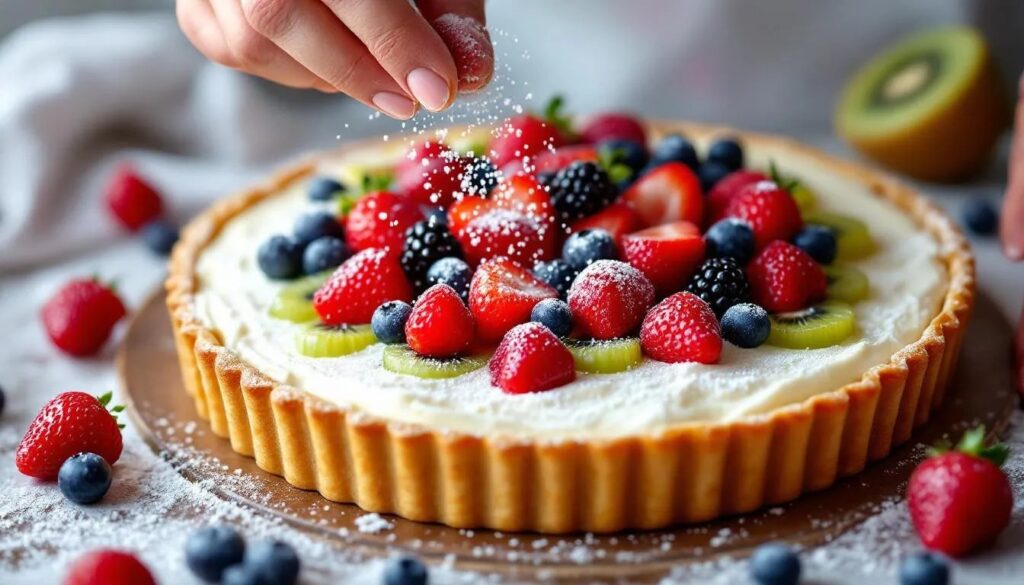
A press-in shortbread crust — made by rubbing cold butter into flour until the mixture resembles coarse sand, then pressing it directly into the tart pan without rolling — holds a filling of whole-milk ricotta loosened with a spoonful of honey and the zest of one unwaxed lemon. Strawberries are halved, placed cut-side down in concentric rings, and glazed with a warm honey-thyme syrup. The result is fragrant, slightly savory at the edges, and surprisingly light on the palate.
2. Rhubarb and almond galette
A galette is a free-form tart — no tart pan, no crimping mold, just rough pastry folded up around its filling on a parchment-lined sheet. Here the filling is frangipane, an almond cream made from equal weights of butter, sugar, ground almonds, and eggs, beaten together until pale. Rhubarb stalks, sliced on a bias, are pressed into the surface before baking. At 350°F (180°C), the frangipane puffs around the rhubarb, which softens and releases its juice into the almond base. The edges of the pastry go deep gold.
3. Lemon posset with shortbread fingers
A posset is one of the oldest English desserts still worth making. It sets through the action of citric acid on warm cream — no eggs, no gelatin, no bain-marie. Bring 2 1/2 cups of heavy cream and 2/3 cup of superfine sugar to a rolling boil for three minutes, remove from heat, stir in the juice of two unwaxed lemons, and pour immediately into glasses. After four hours in the refrigerator the cream is silky and just firm enough to hold a spoon's impression. Serve with shortbread that still smells of butter.
4. Apricot and cardamom upside-down cake
Early-season apricots, still firm and slightly tart, hold their shape under the weight of a cardamom-scented sponge. Butter and brown sugar are melted together in a 9-inch cast-iron skillet, apricot halves arranged cut-side down across the surface, and then covered with a batter fragrant with ground cardamom and a pinch of black pepper. After 35 minutes at 345°F (175°C), the pan is inverted onto a serving plate. The apricots caramelize against the sugar, their edges catching a deep amber that smells of stone fruit and warm spice.
5. Strawberry pavlova with rose cream
A pavlova — meringue crust crisp enough to shatter at the touch, interior chewy and marshmallow-soft — is one of the few desserts that genuinely benefits from spring humidity, which softens the outer shell slightly and blurs the line between crunchy and yielding. The cream is whipped to soft peaks and scented with a few drops of rose water, never so much that it reads as soap. Macerated strawberries, sliced and sugared an hour before serving, pool their juice across the cream and drip down the sides of the meringue.
6. Blood orange olive oil cake
Blood oranges linger into March and early April, their flesh the color of garnets, their flavor more complex than a navel orange — slightly raspberry-like, slightly bitter at the skin. Replacing butter with a fruity olive oil in this single-layer cake produces a crumb that stays moist for two days without refrigeration. The batter is simple: 3 eggs, 1 cup of sugar, 3/4 cup of mild olive oil, the zest and juice of two blood oranges, and 1 3/4 cups of all-purpose flour mixed with a teaspoon each of baking powder and fine salt. Bake at 340°F (170°C) for 40 minutes. Finish with a blood orange glaze while still warm.
7. Strawberry basil sorbet
Process 1 1/4 lb of hulled strawberries with 1/2 cup of sugar syrup, the juice of half a lemon, and six large fresh basil leaves until completely smooth. Pass through a fine-mesh sieve to remove seeds. Churn in an ice cream machine until the texture resembles firm soft-serve, then transfer to a container and freeze for at least two hours. The basil stays in the background — green, slightly peppery — and lifts the strawberry without announcing itself.
8. Rhubarb fool
Cook 14 oz of trimmed rhubarb cut into 1-inch pieces with 1/3 cup of caster sugar over medium heat until collapsed and deeply pink, about 10 minutes. Allow to cool completely. Whip 1 1/4 cups of heavy cream to soft peaks. Fold the rhubarb compote through the cream in three or four strokes — incompletely, deliberately, leaving pink streaks through the white. Spoon into glasses and refrigerate for 30 minutes before serving.
9. Lemon tart with a burnt top
The filling here is a classic lemon curd — eggs, sugar, butter, and lemon juice cooked gently until thick enough to coat the back of a spoon — poured into a pre-baked pâte sucrée shell and returned to a low oven at 285°F (140°C) for 15 minutes to set. After chilling, a thin layer of sugar is spread across the surface and caramelized with a kitchen torch until the top blisters and browns in uneven patches. The contrast between cold curd and warm, crackling caramel is the point of the dessert.
10. Mango and lime cheesecake (no-bake)
A no-bake cheesecake avoids the risk of cracking and the need for a water bath. The base is crushed digestive biscuits bound with melted butter, pressed firmly into a springform pan and chilled for 20 minutes. The filling combines 1 3/4 lb of full-fat cream cheese softened to room temperature, 1/2 cup of powdered sugar, the zest and juice of two limes, and 3/4 cup + 2 tbsp of heavy cream whipped separately to soft peaks then folded in. Pour over the base, smooth the top, and refrigerate overnight. Serve with sliced mango and a few shards of lime zest.
11. Cherry clafoutis
Traditional clafoutis from the Limousin region of France uses unpitted cherries — the stone releases a faint almond flavor during baking. If you prefer to remove them, add a few drops of almond extract to the batter instead. Whisk 3 eggs with 1/3 cup + 2 tbsp of sugar, 1/2 cup of flour, 1 1/4 cups of whole milk, and a pinch of salt until smooth. Butter a gratin dish, scatter 10 1/2 oz of cherries across the base, pour the batter over, and bake at 355°F (180°C) for 30–35 minutes until the custard is set and the top is golden and puffed at the edges. Dust with powdered sugar while still warm.
12. Strawberry shortcake stacks
These are not the supermarket sponge rounds soaked in syrup. The shortcake here is a scone-adjacent biscuit — made with butter cut into flour until the mixture is shaggy, bound with cold buttermilk, barely mixed, and baked at 430°F (220°C) for 14 minutes until risen and pale gold. Split while warm. Layer with sliced, sugared strawberries and softly whipped cream. The biscuit's crumble against the cold cream and the sweet strawberry juice is the entire argument for making it.
13. Lemon mousse with candied peel
Separate 4 eggs. Whisk the yolks with 1/2 cup of sugar and the zest of two lemons until pale and ribbon-like. Fold in 1/3 cup + 2 tbsp of lemon juice. Whip the whites to stiff peaks. Gently fold a third of the whites into the yolk mixture to loosen it, then fold in the rest in two additions, keeping as much air as possible. Pour into glasses and refrigerate for at least 3 hours. Finish with strips of candied lemon peel, which add a marmalade-like bitterness against the airy mousse.
14. Apricot compote with vanilla panna cotta
Panna cotta — Italian for "cooked cream" — is set with just enough gelatin to hold its shape when unmolded: 2g of gelatin per 100ml of cream produces a texture that quivers and barely holds, which is the goal. Infuse 2 cups of cream + 1 tbsp with a split vanilla pod, sweeten with 1/4 cup + 1 tbsp of sugar, dissolve the soaked gelatin off the heat, and pour into lightly oiled molds. Refrigerate overnight. The apricot compote — cooked with sugar and a splash of white wine until jammy — cuts through the cream's richness with something sharp and bright.
15. Elderflower and gooseberry trifle
Gooseberries arrive in late spring, sharp and slightly grassy, and their sourness pairs beautifully with the floral sweetness of elderflower cordial. Layer a trifle bowl with cubes of plain sponge cake soaked in elderflower cordial, gooseberry compote cooked down with a little sugar, a thick layer of set custard made from egg yolks, cream, and sugar, and a final crown of whipped cream. Refrigerate for at least 4 hours before serving so the layers meld and the sponge absorbs the compote completely.
16. Strawberry granita
A granita requires no machine and no churning. Blend 1 1/4 lb of hulled strawberries with 1/2 cup of sugar, the juice of one lemon, and 3/4 cup + 2 tbsp of cold water. Pour into a shallow metal tray and place in the freezer. Every 30 minutes for 3 hours, drag a fork across the surface to break up the ice crystals. The result is a coarse, jewel-red ice that melts on the tongue faster than sorbet. Serve in chilled glasses with a sprig of fresh mint.
17. Rhubarb and custard tart
This is a tart in two acts. First, a crème brûlée-style custard — egg yolks, cream, sugar, vanilla — is poured into a blind-baked shell and set at 300°F (150°C) for 25 minutes until just barely wobbly in the center. Then, roasted rhubarb — stalks cut into batons, tossed with sugar and a splash of orange juice, roasted at 355°F (180°C) for 12 minutes — is arranged across the cooled custard. The rhubarb's acidity cuts through the richness of the cream filling in every bite.
18. Lemon drizzle loaf
One of the most forgiving cakes in the repertoire. Cream 3/4 cup + 2 tbsp of unsalted butter with 1 cup of sugar until pale and almost white. Add 4 eggs one at a time. Fold in 1 3/4 cups of self-rising flour and the zest of two lemons. Bake in a lined 2lb loaf tin at 355°F (180°C) for 45–50 minutes. While still warm, pierce all over with a skewer and pour a mixture of 3 tablespoons of lemon juice and 3 tablespoons of granulated sugar across the top. The sugar crust that forms as it cools is what distinguishes a drizzle loaf from a simple lemon cake.
19. Mango lassi pots
Set with a small amount of gelatin, these chilled pots — halfway between a drink and a dessert — are made by blending ripe mango flesh with whole-milk yogurt, a few tablespoons of sugar, a pinch of ground cardamom, and enough warm water to dissolve the bloomed gelatin. Pour into small glasses and refrigerate for 2 hours minimum. They are pale gold, faintly perfumed, and cool in a way that feels specifically designed for a warm spring afternoon.
20. Strawberry and cream mille-feuille
A mille-feuille — literally "a thousand leaves" — is built from layers of pâte feuilletée (puff pastry) baked flat under a weighted tray to prevent uneven rising, then cooled and cut into rectangles. Layer with crème diplomat — pastry cream lightened with whipped cream — and fresh sliced strawberries. Stack three layers high. The pastry shatters at the first press of a fork and the cream collapses forward in the most satisfying way. Dust the top layer with powdered sugar and stripe with caramel if you want the full effect.
21. Apricot and pistachio financiers
Financiers are small French cakes built around beurre noisette — butter cooked past melting until the milk solids brown and smell of hazelnuts. This brown butter is combined with ground almonds, flour, powdered sugar, and egg whites (never whole eggs), producing a batter that bakes into something dense, moist, and slightly chewy at the edges. Press a small piece of apricot into the center of each mold before baking, and scatter chopped pistachios across the top. Bake at 375°F (190°C) for 12–14 minutes until the edges are deep gold.
22. Spring fruit pavlova wreath
For a table centerpiece, pipe meringue into a ring shape on a parchment-lined tray using a star nozzle. Bake at 210°F (100°C) for 2 hours, then leave in the oven with the door ajar to cool completely. Top with whipped cream and arrange seasonal fruit across the surface: halved strawberries, segments of blood orange, sliced kiwi, a few sprigs of fresh mint. The contrast between the bone-white meringue and the colors of the fruit is worth photographing before serving.
23. Lemon curd cheesecake bars
Pressed into a square pan and cut into bars, these are more portable and less ceremonial than a full cheesecake. The base is a mixture of crushed graham crackers and melted butter. The filling is cream cheese beaten smooth with sugar, eggs, and vanilla, poured over the base, then dotted with spoonfuls of homemade lemon curd swirled through with the tip of a knife. Bake at 320°F (160°C) in a water bath for 35 minutes until set with a slight wobble. Refrigerate for four hours before cutting.
24. Rhubarb sorbet with ginger
Simmer 14 oz of rhubarb with 2/3 cup of sugar, 0.6 cup of water, and a thumb-sized piece of fresh ginger, sliced. Cook until the rhubarb has completely collapsed, about 15 minutes. Blend until smooth and pass through a sieve. Chill completely before churning in an ice cream machine. The ginger adds warmth that makes the sorbet feel more complex than its three main ingredients suggest. The color — deep rose pink — is one of the most striking in any dessert repertoire.
25. Passion fruit and coconut tart
A coconut shell — ground desiccated coconut pressed into flour and butter — forms the base. The filling is a curd made from passion fruit pulp (strained of most of its seeds), eggs, sugar, and butter, cooked to a thick, glossy pour. Set at room temperature in the shell, the curd firms enough to slice cleanly. Each spoonful tastes intensely tropical and sharp, which the sweet coconut pastry balances without dulling.
26. Strawberry balsamic ice cream
A Philadelphia-style ice cream — no eggs, no custard base — relies entirely on the quality of its cream and fruit. Macerate 1 1/3 lb of hulled, sliced strawberries with 1/2 cup of sugar and 2 tablespoons of aged balsamic vinegar for one hour. Blend half the mixture smooth, leave the other half chunky. Combine with 2 cups of cold heavy cream + 1 tbsp and churn in an ice cream machine. The balsamic deepens the strawberry flavor without making itself known as an ingredient. It simply makes the fruit taste more like itself.
27. Lemon and poppy seed friands
The same logic as financiers applies here — egg whites, ground almonds, brown butter — but the flavor comes from lemon zest and a generous tablespoon of poppy seeds that add a faint nuttiness and a slight crunch against the moist crumb. Bake in oval friand molds or in a standard muffin tin. The surface should dome slightly and crack at the center. While still warm, brush with a lemon syrup made from equal parts juice and sugar, brought briefly to a boil.
28. Apricot jam tart (crostata)
An Italian crostata is built on pasta frolla — a short, sweet, egg-enriched pastry that crumbles at the press of a thumb. Roll two-thirds of the dough into the base of a tart pan. Spread generously with good apricot jam. Roll the remaining dough and cut into strips, lay them in a lattice across the jam. Bake at 355°F (180°C) for 30–35 minutes until the pastry is pale gold and the jam bubbles through the lattice. It tastes better the next day when the jam has set back into the pastry.
29. Elderflower panna cotta with fresh strawberries
Replace the vanilla in a standard panna cotta with 3 tablespoons of good elderflower cordial added off the heat after the gelatin has dissolved. The flavor is floral and unmistakably of late spring — hedgerows in England, linden trees in central Europe. Unmold onto plates and surround with halved strawberries macerated with a pinch of black pepper and a few drops of balsamic. The elderflower's sweetness and the berry's acidity bracket each other perfectly.
30. Whole lemon almond cake (gluten-free)
Boil 2 whole unwaxed lemons for 2 hours until completely soft, then blend them — skin, pith, and all — into a smooth purée. Combine with 6 eggs, 2 1/2 cups of ground almonds, 1 cup + 1 tbsp of sugar, and 1 teaspoon of baking powder. Pour into a greased springform pan and bake at 340°F (170°C) for 1 hour, covering with foil after 40 minutes if the top colors too quickly. The result is dense, moist, and intensely lemon-flavored with a complexity that comes from using the whole fruit. It is naturally gluten-free and keeps for four days.
Chef's notes on buying spring fruit
Smell before you buy. A strawberry that smells like nothing in the box will taste like nothing on the plate. Rhubarb stalks should snap when bent — if they bend without breaking, they've been sitting too long. Apricots should yield slightly at the shoulder when pressed. Lemons should feel heavy for their size, which signals juice content. At farmers' markets in late March and April, ask which varieties were picked that morning. The difference between same-day and two-day-old soft fruit is not subtle.
Dessert and drink pairings
Spring fruit desserts call for wines with enough acidity and freshness to match the fruit rather than overwhelm it. The goal is a pairing where neither the wine nor the dessert dominates — they simply make each other more coherent.
For strawberry-based desserts, a demi-sec Vouvray from the Loire Valley — made from Chenin Blanc, with notes of quince and honeycomb — bridges the fruit and cream without overpowering either. Rhubarb preparations work well with a late-harvest Riesling from Alsace, whose bright acidity mirrors the tartness of the rhubarb. Lemon-forward desserts are notoriously difficult to pair with wine; a Moscato d'Asti, lightly sparkling and low in alcohol, is one of the few wines that rises to the challenge without cloying. For those avoiding alcohol, a cold-pressed apple and elderflower juice — sharp and floral — serves as a considered alternative across almost all of these thirty recipes.
Nutritional overview
Nutritional values (per average serving, approximate values)
| Nutrient | Typical range across recipes |
|---|---|
| Calories | ~180–420 kcal |
| Protein | ~3–8 g |
| Carbohydrates | ~25–55 g |
| of which sugars | ~18–40 g |
| Fat | ~8–22 g |
| Fiber | ~1–4 g |
| Vitamin C (fruit-forward recipes) | ~15–60% DV |
Frequently asked questions
Can I make these desserts ahead of time?
Most of these recipes benefit from at least a few hours of resting time. Panna cotta, cheesecake, trifle, and mousse all need a minimum of two to four hours refrigeration to set properly — and all improve overnight. Tarts and galettes are best the day they are made, though the pastry can be pre-baked and stored unfilled for up to 24 hours. Sorbets and granitas need to be made at least three hours before serving but keep well in the freezer for up to a week.
What's the best way to store leftover spring desserts?
Cream-based desserts — panna cotta, mousse, pavlova with cream — should be consumed within 24 to 48 hours and kept refrigerated and covered. Cakes like the lemon drizzle loaf and the whole lemon almond cake keep at room temperature for three to four days, loosely wrapped. Sorbets and ice creams should be transferred to airtight containers and placed at the back of the freezer where the temperature is most stable. Bring them out five minutes before serving to allow them to soften slightly at the edges.
Which recipes work for guests with dietary restrictions?
Recipe 30 — the whole lemon almond cake — is naturally gluten-free and requires no substitutions. Recipes 7, 16, and 24 (the sorbets and granita) are vegan as written. The mango lassi pots can be made vegan by using coconut yogurt. For guests avoiding dairy, the granita, sorbet, and fruit compotes work without modification. Always check that any packaged ingredient — biscuit bases, puff pastry — carries the appropriate certification before serving to guests with celiac disease or serious allergies.
Can I substitute frozen fruit for fresh in these recipes?
For cooked preparations — compotes, jams, clafoutis, upside-down cakes, galette fillings — frozen fruit works well and is sometimes preferable in early spring when fresh stone fruit is not yet available. Thaw frozen fruit completely and drain off the excess liquid before using; otherwise, the moisture will affect the texture of pastry or custard. For raw preparations — pavlova toppings, shortcake fillings, granita served immediately — fresh fruit is worth seeking out. The difference in texture and juice content between frozen and fresh strawberries, for example, is significant enough to matter.
How do I know when meringue is properly baked?
A pavlova or meringue wreath is done when the exterior is dry enough to peel cleanly from parchment without sticking. Tap the underside — it should sound hollow. The interior will always remain soft; that is intentional and correct. If the meringue begins to color more than a pale cream, reduce the oven temperature by 10°F and extend the baking time. Always cool meringue in the oven with the door ajar after baking — removing it too quickly into a cooler room can cause the surface to crack from the thermal shock.
What makes a spring dessert different from a summer one?
Spring fruit tends to be sharper, brighter, and more fragrant than summer fruit, which is often richer and more concentrated by heat. Strawberries in April have more acidity than those in July. Rhubarb is available almost exclusively in spring. Blood oranges and Meyer lemons are finishing their season. This means spring desserts often rely on contrast — acid fruit against sweet cream, tart compote against neutral pastry — rather than the standalone intensity of a summer peach or a fully ripe August tomato. Spring baking also tends toward lighter textures: mousses, sorbets, thin-shelled tarts, rather than the cobblers and crumbles of autumn.