
There's a moment every home cook knows too well: you bite into a meatball and it's dense, rubbery, a little dry — nothing like the pillowy, yielding spheres that arrive steaming in a proper Italian trattoria. The problem almost never lies with the sauce. It starts with the meat, and more precisely, with how little we tend to treat it before shaping. Ground pork from the supermarket is perfectly capable of producing extraordinary results — it just needs one unconventional step before anything else happens in the kitchen.
Massaging ground pork with a small amount of baking soda for a brief resting period raises the meat's pH, which prevents proteins from contracting too aggressively during cooking. The result is a meatball with a genuinely tender, almost silky interior — the kind that holds its shape in a long-simmered tomato sauce without ever turning tough. This technique, borrowed from Chinese restaurant kitchens and increasingly adopted by Italian-American cooks, transforms an everyday supermarket ingredient into something worth writing home about. Late March is an ideal moment to master it: the evenings are still cool enough to want something simmered low and slow, and a pot of meatballs in tomato sauce fills the kitchen with a warmth that no spring salad can rival. Tie on your apron.
| Preparation | 25 min |
| Resting | 20 min |
| Cooking | 40 min |
| Portions | 4 people (approx. 20 meatballs) |
| Difficulty | Easy |
| Cost | $$ |
| Season | All year — ideal in early spring for low-and-slow Sunday cooking |
Suitable for: Dairy-free (if Parmesan is omitted) · High-protein
Ingredients
For the meatballs
- 1.1 lb (500 g) supermarket ground pork (around 20% fat content for best results)
- ¾ tsp baking soda
- 1 tbsp cold water
- 2 slices stale white bread, crusts removed (about 1.5 oz / 45 g)
- 3 tbsp whole milk
- 1 large egg
- 2 garlic cloves, finely grated
- 1 oz (30 g) Parmigiano Reggiano, finely grated
- 2 tbsp flat-leaf parsley, finely chopped
- ½ tsp fine salt
- ¼ tsp black pepper, freshly ground
- ¼ tsp ground nutmeg
- 2 tbsp olive oil, for browning
For the tomato sauce
- 1 can (28 oz / 800 g) whole peeled tomatoes, San Marzano-style
- 2 garlic cloves, thinly sliced
- 3 tbsp extra-virgin olive oil
- ½ tsp fine salt
- 1 tsp granulated sugar (optional, to balance acidity)
- 4–5 leaves fresh basil
Equipment
- Large mixing bowl
- Small bowl (for soaking bread)
- Microplane or fine grater
- Wide, heavy-bottomed pan or Dutch oven with lid
- Wooden spoon or silicone spatula
- Kitchen scale or measuring spoons
- Plate lined with parchment paper (for resting shaped meatballs)
Preparation
1. Treat the pork with baking soda
Remove the ground pork from its packaging and place it in a large mixing bowl. In a small bowl, dissolve ¾ teaspoon of baking soda in 1 tablespoon of cold water and pour it directly over the meat. Using your hands — or a fork if you prefer — work the liquid into the pork with a firm massaging motion, distributing it evenly throughout. This process, known in Cantonese cooking as velveting, raises the pH of the meat's surface, which limits how tightly the muscle proteins bond when exposed to heat. The result: a meatball that stays genuinely soft inside, rather than snapping back into a tight, bouncy ball. Once the baking soda mixture is fully incorporated, cover the bowl loosely with plastic wrap or a plate and refrigerate for 20 minutes. No longer — an extended rest can produce an unpleasant, slightly soapy aftertaste.
2. Prepare the panade
While the pork rests, tear the stale bread into rough pieces and place them in a small bowl. Pour the 3 tablespoons of whole milk over the top and press down gently with a fork. Let the bread soak for 5 minutes until it has absorbed all the milk and become completely soft. Mash it into a rough paste — this mixture is called a panade, a binder used in French and Italian cooking alike. Its role is structural: starch molecules from the bread swell and form a soft scaffolding inside each meatball, preventing the proteins from squeezing out too much moisture as they cook. A dry meatball is almost always one that was shaped without enough panade, or with bread that was never properly hydrated.
3. Build the mixture
Remove the pork from the refrigerator. Add the mashed bread panade, the whole egg, the finely grated garlic, the Parmigiano Reggiano, the chopped parsley, the salt, pepper, and a light grating of nutmeg. Mix everything together using your hands, working gently but thoroughly — you want a uniform mixture without any visible streaks of egg or bread, but you should stop the moment everything comes together. Overworking the mixture compacts the proteins and undoes much of what the baking soda accomplished. Think of it less like kneading dough and more like folding: deliberate, minimal, just enough. The mixture should look slightly sticky and hold together when you press a small amount between two fingers.
4. Shape the meatballs
Line a plate or small tray with parchment paper. Using a tablespoon measure or a small ice cream scoop for consistency, portion the mixture into roughly equal amounts — each around 1 heaped tablespoon, producing a meatball approximately 1.5 inches (4 cm) in diameter. Roll each portion between damp palms in a smooth, circular motion, applying just enough pressure to form a cohesive sphere. Wet hands prevent the mixture from sticking and produce a cleaner surface. Place each shaped meatball on the parchment-lined plate without crowding them. You should end up with around 20 pieces.
5. Brown the meatballs
Heat 2 tablespoons of olive oil in a wide, heavy-bottomed pan over medium-high heat until the oil shimmers and moves freely. Add the meatballs in a single layer, working in two batches if your pan won't fit them all without touching. Leave them undisturbed for 2–3 minutes before attempting to turn them — they release naturally from the pan when a golden crust has formed. The sound should be a steady, confident sizzle. Rotate them to brown two or three sides; you don't need a complete exterior crust since they'll finish cooking in the sauce. Remove to a plate and repeat with the second batch. This browning step creates Maillard reaction compounds — complex, savory, slightly caramelized flavors that a simmered-from-raw meatball simply cannot achieve.
6. Build and simmer the tomato sauce
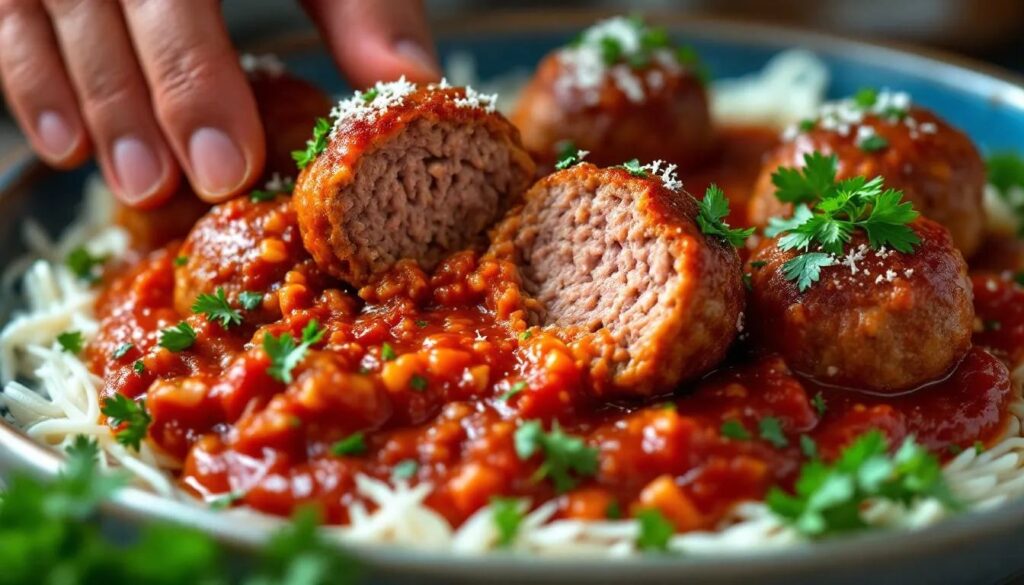
Discard any excess oil from the pan, leaving about 1 tablespoon of the browned drippings behind. Add the 3 tablespoons of extra-virgin olive oil and the sliced garlic over medium heat. Cook the garlic until it turns pale gold at the edges — about 90 seconds — then crush the whole peeled tomatoes directly into the pan with your hands, letting them fall in rough, uneven pieces. Alternatively, use a wooden spoon to break them against the side of the pan. Add the salt and sugar if using, stir once, and let the sauce bubble for 5 minutes, reducing slightly. Nestle the browned meatballs into the sauce, turning to coat, then lower the heat to a gentle simmer. Cover the pan with a lid slightly ajar and cook for 25 minutes, turning the meatballs once at the halfway point. The sauce should be thick enough to coat a spoon; the meatballs should feel firm to a light press but yield without resistance inside. Tear the basil leaves over the top just before serving.
Chef's tip
The baking soda window matters: 15 to 20 minutes in the refrigerator is the sweet spot. Less than that and the tenderizing effect is incomplete; significantly more than 30 minutes and the alkalinity starts to affect flavor in a way that reads as slightly metallic against a bright tomato sauce. Set a timer the moment you cover the bowl. If you're working with a mix of ground pork and ground beef — a common Italian-American approach — the same baking soda ratio applies to the total weight of meat combined. One more detail worth knowing: cold meat shapes more cleanly than room-temperature meat, so keep everything as cold as possible right up until the moment the meatballs go into the pan.
Wine pairing
The meatballs carry sweetness from the pork fat and a savory depth from the browning, while the tomato sauce brings acidity and the faint bitterness of basil. You need a red wine with enough fruit and gentle tannins to sit alongside both without overpowering either.
A Chianti Classico (Sangiovese-based, Tuscany) is the natural reference point here: its medium body, cherry-forward fruit, and natural acidity mirror the tomato's character while its earthy undertone complements the pork. A Barbera d'Asti from Piedmont offers a more plush, fruit-driven alternative with lower tannins — approachable and crowd-pleasing. For a non-alcoholic pairing, a sparkling water with a squeeze of blood orange and a few torn basil leaves keeps the table cohesive without competing with the dish.
About this dish
The Italian-American meatball — large, sauced, and centered on the plate — is largely a product of immigration rather than a direct export from the Italian peninsula. In southern Italy, polpette are typically smaller, often pan-fried and eaten without sauce, or added to a ragù in modest quantities. When Italian immigrants settled in the United States in the late 19th and early 20th centuries, they found meat more affordable than it had been at home, and the meatball grew — in size, in quantity, and eventually in cultural prominence. What emerged was a distinct culinary tradition, neither purely Italian nor entirely American, but something new built on memory and adaptation.
The baking soda technique itself has no Italian origin. It comes from Chinese velveting — a method used in stir-fry cooking to keep thin-sliced meat tender at high heat. Its application to ground meat in meatballs is a more recent development, popularized by food science writers and home cooks who began applying the technique's logic beyond its original context. The fact that it works equally well in an Italian-American kitchen says something useful about cooking: a good technique is rarely the exclusive property of one tradition.
Nutritional values (per serving, approximate values)
| Nutrient | Amount |
|---|---|
| Calories | ~480 kcal |
| Protein | ~32 g |
| Carbohydrates | ~14 g |
| of which sugars | ~6 g |
| Fat | ~33 g |
| Fiber | ~2 g |
Frequently asked questions
Can the meatballs be prepared ahead of time?
Yes — and they improve with time. You can complete the recipe through the simmering step, then refrigerate the meatballs in their sauce for up to 3 days. The collagen from the meat gradually enriches the sauce, and the flavors knit together more completely overnight. Reheat gently over low heat with the lid on, adding a splash of water if the sauce has thickened too much.
Can I freeze these meatballs?
Both the cooked meatballs in sauce and the raw shaped meatballs freeze well. For raw meatballs, freeze them in a single layer on a parchment-lined tray first, then transfer to a freezer bag once solid — this prevents them from sticking together. Cook directly from frozen, adding a few extra minutes to the browning step. Cooked meatballs in sauce keep in the freezer for up to 3 months; thaw overnight in the refrigerator before reheating.
What substitutions work in this recipe?
Ground pork can be partially replaced with ground veal or beef — a classic Italian-American blend uses equal parts of all three. For a dairy-free version, soak the bread in unsweetened oat milk instead of whole milk and omit the Parmigiano. If you don't have stale bread, lightly toast fresh bread in a dry pan for 2–3 minutes before soaking — the principle is the same: you need a dry crumb that will fully absorb the liquid and create a soft paste.
Does the baking soda affect the flavor?
When used within the recommended quantity and resting time, baking soda leaves no detectable taste in the finished meatball. The alkalinity neutralizes during cooking, particularly in the presence of acidic tomato sauce. What remains is purely textural: a measurably softer, more yielding interior than you'd achieve without it. If you're nervous about the quantity, start with ½ teaspoon for 500 g of meat on your first attempt.
Why are my meatballs falling apart in the pan?
The most common cause is a mixture that is too warm or too wet. Make sure the meat stays cold until shaping, and don't overhydrate the bread — the panade should be a paste, not a liquid. A second frequent issue is turning the meatballs too early during browning: they will release cleanly from the pan on their own once a crust has set. If they resist, wait another 30 seconds rather than forcing them. A properly browned meatball holds together with confidence.