



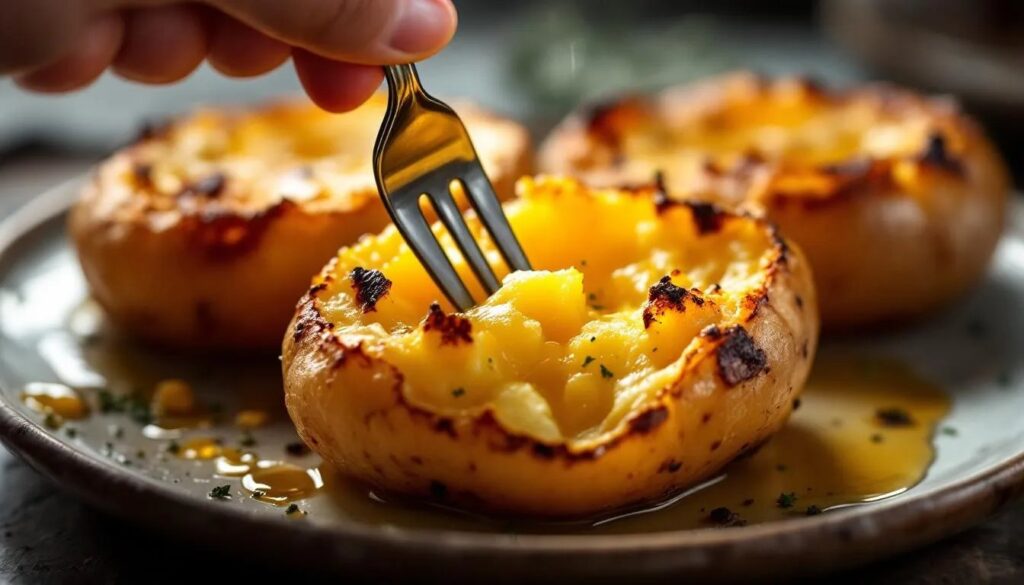
Easter Sunday calls for a table that feels alive — and nothing does that quite like batata bolinha ao murro, the Portuguese smashed baby potato that crackles at first bite and melts into herbed, garlicky warmth just beneath the crust. As spring arrives in full force, markets are bursting with waxy, thin-skinned little potatoes that hold their shape under pressure and reward you with a fluffy, almost cloud-like interior once crushed and roasted. This is the side dish that earns its place beside salt cod, slow-roasted lamb, or any centerpiece your Easter table demands.
The name says it all: ao murro literally means "punched" — a single firm press applied to each boiled potato before it meets high oven heat. That act of compression splits the skin, exposes the starchy interior, and creates the uneven, cratered surface that crisps so beautifully in olive oil. No elaborate technique, no specialist equipment, no last-minute stress: just a trustworthy method rooted in Portuguese home cooking that produces results far greater than the sum of its parts. Pull on your apron, and let's get into it.
| Preparation | 10 min |
| Cooking | 45 min |
| Portions | 4–6 people |
| Difficulty | Easy |
| Cost | € |
| Season | Spring baby potatoes, fresh flat-leaf parsley, new garlic |
Suitable for: Vegan · Vegetarian · Gluten-free · Dairy-free
Ingredients
- 800 g baby potatoes (batata bolinha), skin on, uniform in size
- 6 tablespoons good extra-virgin olive oil, divided
- 4 cloves garlic, thinly sliced or finely grated
- 1 teaspoon flaky sea salt, plus extra for the cooking water
- ½ teaspoon coarsely cracked black pepper
- 1 teaspoon sweet smoked paprika (pimentão doce)
- ½ teaspoon dried oregano
- A small handful fresh flat-leaf parsley, leaves roughly chopped
- 1 tablespoon fresh lemon juice
- Optional: fresh rosemary sprigs, a pinch of dried chili flakes
Equipment
- Large saucepan
- Colander
- Large baking tray, preferably heavy-gauge metal
- The flat base of a heavy glass, ramekin, or your palm wrapped in a clean cloth
- Small mixing bowl
- Sharp knife and chopping board
- Tongs
Preparation
1. Choosing and prepping the potatoes
Select baby potatoes that are as close to the same size as possible — ideally between 3 and 4 cm in diameter. Uniformity here isn't just for looks; it ensures they cook through in the same amount of time, both during boiling and roasting. Scrub the skins thoroughly under cold running water but leave them entirely intact. The skin is structural — it holds the potato together through the punching stage and then crisps to a thin, shattering shell in the oven. If some of your potatoes are noticeably larger, halve them before boiling rather than trying to compensate later.
2. Boiling to the right texture
Place the potatoes in a large saucepan and cover generously with cold water — starting from cold allows the heat to penetrate evenly from the center outward. Season the water with a good tablespoon of salt; the potato absorbs seasoning as it cooks, and this early step is what prevents a bland core. Bring to a steady boil over medium-high heat, then reduce to a firm simmer and cook for 18 to 22 minutes, depending on size. You're looking for a potato that a thin knife pierces with almost no resistance but that doesn't collapse when lifted with a spoon. Drain immediately into a colander and leave to steam-dry for 5 full minutes: excess moisture on the surface will inhibit crisping later, so this rest is not optional.
3. Preheating — the non-negotiable step
Set your oven to 430°F (220°C) and place the empty baking tray inside from the very start of preheating. A cold tray produces steamed, leathery potatoes; a screaming-hot tray produces the instant sizzle that seals and crisps the surface within the first minute. Allow at least 15 minutes of tray preheating — this is the single most important technical detail in the recipe. While the tray heats, combine 4 tablespoons of olive oil in a small bowl with the garlic, paprika, oregano, salt, and pepper. Stir briefly and leave to infuse.
4. The punch
Working on a sturdy surface, place each dried, cooled potato flat and apply a single firm, downward press using the base of a glass or ramekin. The motion should be confident and deliberate — not so violent that the potato shatters completely but firm enough to crack the skin and flatten the potato to roughly half its original height. The resulting shape, with its split surface and uneven edges, is exactly what you want: every rough edge and exposed crevice will become a point of intense crispness in the oven. Aim for consistency — each potato pressed to roughly the same thickness — so they roast at the same rate.
5. Seasoning and hitting the hot tray
Remove the baking tray from the oven — you should hear it radiating heat. Working quickly, drizzle 2 tablespoons of plain olive oil across the surface, then arrange the smashed potatoes in a single, uncrowded layer. Crowding is the enemy of crispness: if the potatoes touch, steam builds between them and the texture suffers. Spoon half the garlic-oil mixture over the top of the potatoes, making sure each one receives a share. Return the tray to the upper third of the oven and roast for 20 to 25 minutes, without disturbing them. Resist the urge to shuffle. At the 20-minute mark, check the underside of one potato with a spatula: you're looking for deep golden-brown with occasional darker edges and a texture that sounds hollow when tapped.
6. Finishing with herbs and lemon
Remove the tray from the oven. Spoon the remaining garlic-oil mixture over the potatoes while they are still sizzling — the residual heat will mellow the raw garlic slightly and bloom the paprika's aroma. Scatter generously with the chopped flat-leaf parsley and finish with a squeeze of fresh lemon juice. The acid cuts through the richness of the olive oil and elevates the whole dish. Transfer immediately to a warm serving dish and season with a final pinch of flaky salt directly on top.
My chef's tip
For Easter gatherings, these potatoes can be boiled and punched up to six hours in advance, then kept uncovered at room temperature on the baking tray. The surface dries further as they wait, which actually improves the final crisp. When your guests arrive and your main course goes into the oven, slide the tray in at the same time — 430°F works alongside most slow roasts. In spring, if you can find alho novo (fresh spring garlic) at a farmers' market, use it instead of dried cloves: its flavor is brighter, more floral, and far less aggressive once roasted.
Pairing suggestions
These potatoes carry enough flavor — smoky paprika, olive oil, sharp herbs — to hold their own, yet their role is fundamentally generous: they support without competing. The right accompaniments amplify that balance.
As an Easter side, they are classically served alongside bacalhau assado (baked salt cod), roasted lamb shoulder seasoned with rosemary and garlic, or grilled sea bream. If wine is on the table, reach for a fresh, unoaked Vinho Verde Branco from the Minho region — its mineral acidity and slight effervescence cut through the olive oil cleanly. A lightly chilled Alentejo rosé works equally well, offering enough body to echo the paprika. For a non-alcoholic option, sparkling water with a slice of lemon and a few fresh mint leaves mirrors the same citrus note you finish the dish with.
About this dish
Batata ao murro is a preparation found across Portugal, from northern farmhouse tables to Lisbon tascas, and its simplicity is precisely what has kept it alive across generations. The technique of punching the potato before roasting is older than it looks: before modern ovens became widespread, potatoes were often placed directly in the embers of a wood fire after boiling, pressed flat to maximize contact with the heat. That instinct — to maximize surface area, to coax crispness from something inherently soft — remains unchanged in today's version.
At Easter, potatoes take on particular importance in Portuguese domestic cooking. The weeks of Lent traditionally restrict meat consumption, and potatoes — prepared in ever more inventive ways — carry much of the nutritional and textural weight of the table. Batata bolinha ao murro is spring's answer to that challenge: quick, economical, deeply satisfying. Some households add brined black olives roasted alongside the potatoes in the final five minutes; others finish with a grating of lemon zest instead of juice. Both variations are worth exploring depending on what else sits on the table.
Nutritional values (per portion, approximate values)
| Nutrient | Quantity |
|---|---|
| Calories | ~210 kcal |
| Protein | ~3 g |
| Carbohydrates | ~28 g |
| of which sugars | ~2 g |
| Fat | ~10 g |
| Fiber | ~3 g |
Frequently asked questions
Can i prepare these potatoes ahead of time?
Yes — and the result often improves with a head start. Boil and smash the potatoes up to six hours before roasting, then leave them uncovered on the baking tray at room temperature. The exposed surface dries out as they wait, which translates directly into a crisper finish once they hit the hot oven. Do not refrigerate them at this stage: cold potatoes placed on a hot tray tend to steam rather than sear.
How do i store and reheat leftovers?
Store cooled leftover potatoes in an airtight container in the refrigerator for up to three days. To reheat and recover the crisp texture, spread them on a baking tray and return to a 390°F (200°C) oven for 10 to 12 minutes — a microwave will make them soft and leathery. They are also very good eaten at room temperature the following day as part of a composed salad with olives, capers, and hard-boiled eggs.
What substitutions or variations work well?
If you cannot find baby potatoes, small Ratte or Charlotte potatoes work well — cut them into even 4 cm chunks rather than leaving them whole. For a richer, more indulgent version, replace a portion of the olive oil with duck fat. In late spring, fresh thyme or wild garlic leaves can replace the flat-leaf parsley entirely. A spoonful of massa de pimentão (Portuguese red pepper paste) blended into the oil adds depth and a more intensely savory character that particularly suits lamb.
Why do my potatoes come out soft rather than crispy?
There are three usual culprits. First, the potatoes were not dried thoroughly enough after boiling — surface moisture turns to steam in the oven and prevents a crust from forming. Second, the baking tray was not preheated: the potatoes must land on a surface already at full temperature to sear immediately. Third, the tray was overcrowded, causing the potatoes to steam each other rather than roast independently. Address all three and the texture issue will resolve itself.
Can i cook these in an air fryer?
An air fryer works very well for smaller batches. Boil and smash the potatoes as directed, then toss them in the olive oil and seasoning mixture. Cook in a single layer at 390°F (200°C) for 15 to 18 minutes, shaking the basket once halfway through. The result is slightly less caramelized on the underside than the oven version — because there is no contact surface — but the overall texture is excellent and the cooking time is considerably shorter.