

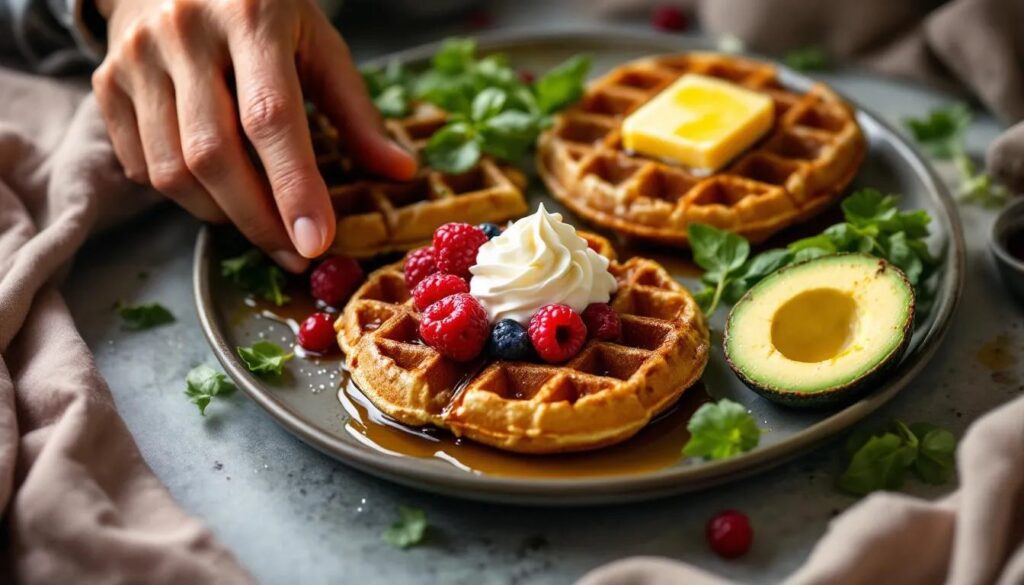
Waffles have been gracing breakfast tables for centuries, yet most people couldn't tell a Brussels waffle from a Liège waffle if their morning depended on it. Spring is the season of light, fresh starts, and weekend brunches that stretch well past noon — and there's no better centerpiece than a properly made waffle, golden at the edges, yielding at the heart. But how well do you actually know this iconic grid-patterned staple?
This quiz covers everything from waffle iron history to the precise ratio of egg whites that makes a batter rise, from the streets of Belgium to the diners of the American South. Twelve questions stand between you and the title of Certified Breakfast Expert. Eleven correct answers earns it. Anything below that, and the waffle gods suggest you keep reading.
Question 1: Where did the modern waffle originate?
Most food historians trace the waffle's direct ancestor to medieval Europe, specifically to the honeycomb-patterned oublies baked on hinged iron plates over open fires in France and the Low Countries. By the 13th century, guild-regulated street vendors known as oublayeurs were selling these hot cakes outside cathedrals in Paris. The grid pattern we recognize today evolved in the Southern Netherlands — present-day Belgium — during the 17th and 18th centuries, when deeper, rectangular molds replaced the shallow round plates. So while many countries claim a piece of waffle history, Belgium holds the most direct line to the modern form.
The answer: Medieval Europe, with Belgium as the primary architect of the modern waffle's form and identity.
Question 2: What is the key structural difference between a Brussels waffle and a Liège waffle?
This is where many self-declared waffle enthusiasts stumble. The Brussels waffle — gaufre de Bruxelles — uses a yeast-leavened batter, sometimes enriched with stiffly beaten egg whites folded in at the last moment. The result is a light, rectangular waffle with deep pockets, a crisp exterior, and an airy crumb. It is traditionally served dusted with powdered sugar, occasionally with whipped cream and strawberries.
The Liège waffle, by contrast, is a denser, rounder affair made from a brioche-style dough rather than a poured batter. Its defining feature is the inclusion of pearl sugar — coarse sugar pearls that caramelize against the hot iron plates, creating a lacquered, almost candy-like crust. No powdered sugar needed. No toppings required. The Liège waffle is complete as it stands, warm from the iron, eaten out of hand on a street corner.
The answer: Brussels waffles use a light, yeast-leavened poured batter; Liège waffles use a dense brioche dough loaded with pearl sugar.
Question 3: What leavening agent is used in most American-style waffle batters?
American diner waffles diverged sharply from their Belgian counterparts during the 19th and 20th centuries. Rather than relying on yeast or laboriously folded egg whites, American recipes standardized around baking powder — and in many buttermilk versions, a combination of baking powder and baking soda, where the soda reacts with the acid in the buttermilk to produce immediate lift. This chemical leavening produces a reliable, consistent waffle that requires no resting time, no planning ahead, and no particular technique. Speed and accessibility won out over complexity, which is very much in keeping with American breakfast culture.
The answer: Baking powder, often combined with baking soda in buttermilk recipes.
Question 4: What is the purpose of separating eggs and folding in the beaten whites?
This technique, borrowed from classic patisserie, is the single most impactful upgrade a home cook can make to any waffle recipe. When egg whites are beaten to stiff peaks — the stage at which the foam holds its shape without drooping — they contain a dense network of air bubbles stabilized by protein. Folding these whites gently into the base batter, using a broad spatula and a deliberate cut-and-fold motion, preserves that air network rather than collapsing it. In the heat of the waffle iron, the trapped air expands, lifting the batter and creating a noticeably lighter, more open crumb. The exterior still crisps from direct contact with the hot plates, but the interior becomes almost soufflé-like.
The answer: Beaten egg whites, folded in gently, trap air that expands under heat, producing a lighter, crispier waffle with an open crumb structure.
Question 5: At what temperature should a waffle iron be set for optimal results?
Most waffle irons operate within a range of 175°C to 220°C (~350°F to 425°F). The sweet spot for classic crispy-outside, tender-inside waffles sits around 190°C to 200°C (375°F to 400°F). Too low, and the batter steams rather than sears — you get a pale, soft waffle that sticks to the plates. Too high, and the exterior burns before the interior sets. Professional waffle makers often advocate for a slightly higher heat with a shorter cook time, which maximizes the Maillard reaction — the complex browning process responsible for flavor development — without drying out the crumb.
The answer: Between 190°C and 200°C (375°F–400°F) for most standard recipes.
Question 6: What is the Maillard reaction, and why does it matter for waffles?
Named after French chemist Louis-Camille Maillard, who described it in 1912, the Maillard reaction is a non-enzymatic browning process that occurs when amino acids and reducing sugars are exposed to heat above approximately 140°C (285°F). For waffles, this means the surface proteins and sugars in the batter transform into hundreds of new flavor compounds simultaneously — nutty, caramel, slightly bitter, deeply savory — while the surface dehydrates and crisps. Without the Maillard reaction, a waffle is simply cooked batter. With it, it becomes something with character. The pearl sugar in Liège waffles undergoes a related but distinct process: caramelization, which is the thermal decomposition of sugar alone, producing its own range of complex flavors.
The answer: A heat-triggered chemical reaction between amino acids and sugars that creates browning and complex flavor development — responsible for the waffle's golden crust and depth of taste.
Question 7: Which American president is associated with introducing waffles to the United States?
Thomas Jefferson is widely credited — though the story has grown into something of a romantic legend — with bringing a long-handled waffle iron back from France after his diplomatic posting there in the 1780s. Whether or not Jefferson personally carried the iron across the Atlantic, his household records and those of his contemporaries confirm that waffle parties, known as waffle frolics, were fashionable in late 18th-century Virginia. Guests would gather in the evening around a fire, taking turns operating the iron, and eating their waffles with butter, sugar, or molasses. The tradition spread quickly through the Eastern Seaboard.
The answer: Thomas Jefferson, who brought a waffle iron from France during the 1780s.
Question 8: What distinguishes a Hong Kong egg waffle (鷄蛋仔) from Western waffles?
The gai daan zai, or egg waffle, is one of Hong Kong's most beloved street foods, appearing on nearly every dai pai dong (outdoor food stall) and hawker cart since the 1950s. Unlike rectangular or round Western waffles with their deep square pockets, the Hong Kong egg waffle is cooked in a specialized mold that produces a pattern of small, round, bubble-shaped protrusions — resembling a grid of eggs, hence the name. The batter is eggy, slightly sweet, and often flavored with evaporated milk, producing a waffle that is crispy on the outside and hollow within the bubbles, with a soft, almost custard-like interior. It is eaten rolled into a cone shape, warm and unadorned, fresh off the street.
The answer: The Hong Kong egg waffle uses a bubble-mold producing round protrusions, made from an evaporated milk–enriched batter, with a crispy exterior and soft, hollow interior — a distinct street food tradition with no Western equivalent.
Question 9: What is the correct resting time for a yeast-based waffle batter?
Patience is the ingredient most home cooks leave out. A yeast-leavened waffle batter — the kind used for Brussels-style waffles — requires a minimum of one hour at room temperature for the yeast to become active, begin fermenting, and produce the carbon dioxide bubbles that will give the batter its lift and its subtle, complex flavor. Many recipes recommend an overnight rest in the refrigerator, a technique known as cold fermentation, which slows yeast activity and allows additional enzymatic processes to develop flavor compounds not achievable with a quick proof. The result the following morning is a batter with gentle acidity, more depth, and superior texture.
The answer: At minimum one hour at room temperature; ideally an overnight cold fermentation for maximum flavor development.
Question 10: Why should you never lift the waffle iron lid too early?
Opening the iron before the waffle has finished setting is one of the most common and destructive mistakes in waffle-making. In the first minute or two of cooking, the batter is still in a semi-liquid state in the center, and the steam being released is actively pushing the batter outward and upward into the mold's pockets. The steam also creates a temporary layer between the batter and the plates that prevents sticking. Interrupting this process by lifting the lid tears the waffle apart — the top half adheres to the upper plate while the underside remains on the lower, and you are left with two broken pieces of half-cooked batter. The rule is simple: wait until steam stops visibly escaping from the sides of the iron. That is the signal that the waffle has fully set and is ready.
The answer: Lifting the lid too early tears the still-liquid waffle apart; wait until steam stops escaping from the iron's sides before opening.
Question 11: What fat produces the crispiest waffle exterior — butter, oil, or shortening?
This question divides breakfast cooks into two firm camps, and the answer depends on what you value most. Clarified butter — beurre clarifié, with its milk solids removed — produces exceptional flavor and a very good crust, but the remaining water content in whole butter can inhibit maximum crispness. Neutral oils (grapeseed, sunflower) produce a crisper exterior than whole butter because they contain no water, and they allow the batter's own sugars and proteins to brown without competition. Shortening (hydrogenated vegetable fat) produces the crispiest result of all, used historically in American diner cooking, but has largely fallen out of favor due to its trans fat content. For the balance of flavor and crispness, most professional recipes today use a combination of clarified butter and a neutral oil.
The answer: Neutral oil produces the crispiest crust; clarified butter adds flavor; the professional compromise is a blend of both.
Question 12: What is the function of pearl sugar in a Liège waffle, and can it be substituted?
Pearl sugar — known as sucre perlé in French or parelsuiker in Dutch — consists of compressed sugar granules that are large, very hard, and have a high melting point. This last quality is the key: pearl sugar does not dissolve into the batter during mixing the way granulated sugar does. Instead, it holds its shape until it comes into direct contact with the hot iron plates, at which point it caramelizes into a glossy, amber-hued lacquer that partially fuses with the waffle's exterior. The result is a surface that is both crunchy and sticky in the specific way that caramelized sugar is — not gummy, not burnt, but crystalline and deeply flavored.
Substituting with regular granulated sugar will not work: it dissolves into the dough and adds sweetness without texture. Crushed sugar cubes can approximate the effect but do not caramelize as evenly. For an authentic Liège waffle, Belgian pearl sugar — widely available in specialty grocers and online — is not a detail but a requirement.
The answer: Pearl sugar caramelizes against the hot iron without dissolving into the dough, creating the Liège waffle's signature lacquered, crunchy crust. It cannot be effectively substituted with granulated sugar.
Your Score: What It Means
| Score | Level |
|---|---|
| 11–12 correct | Certified Breakfast Expert — you know your waffles at a professional level |
| 8–10 correct | Serious Brunch Enthusiast — strong foundations, a few blind spots worth exploring |
| 5–7 correct | Weekend Waffle Maker — competent in the kitchen, still learning the theory |
| 0–4 correct | Start with a Liège waffle from a good bakery, then come back and try again |
The deeper truth about waffles
What makes this quiz harder than it looks is that waffles exist at an unusual crossroads: they are simple enough to be a Tuesday morning staple, yet complex enough to sustain centuries of regional variation, professional technique, and cultural meaning. The Brussels waffle served at a Belgian market in early spring — when the first strawberries appear and the air still carries a chill — is a completely different object from the buttermilk waffle at an American diner at 7 a.m., which is again completely different from a Hong Kong egg waffle eaten rolled into a cone at a night market. They share a grid and a hot iron. The rest is geography, history, and the specific genius of whoever first decided that batter poured onto a patterned plate, pressed between two hot surfaces, and eaten immediately was worth perfecting.
Scoring 11 out of 12 means you understand not just how waffles are made, but why they are made the way they are. That distinction — between following a recipe and understanding it — is what separates a breakfast cook from a breakfast expert.
Frequently asked questions
What is the single most important technique for crispier waffles at home?
Separate your eggs and fold stiffly beaten whites into the batter just before cooking. Beyond that, ensure your iron is fully preheated before adding batter — a cold or lukewarm iron produces pale, soft waffles regardless of the recipe. If your iron has a temperature dial, let it sit at full heat for at least three minutes before the first pour.
Can waffle batter be made the night before?
For yeast-based batters, overnight refrigeration is actively recommended — it improves flavor through slow fermentation and means very little morning effort. For chemical-leavening batters (baking powder or baking soda), the batter can rest overnight in the fridge, but expect slightly less lift, as the leavening begins reacting on contact with wet ingredients. Add the beaten egg whites, if using, only just before cooking, never the night before.
How do you keep waffles crispy while cooking multiple batches?
Place finished waffles directly on the oven rack — not on a plate, and absolutely not stacked — in an oven set to 90°C to 100°C (200°F). A plate traps steam underneath and softens the crust within minutes. The oven rack allows air to circulate around the entire waffle surface, maintaining crispness for up to 20–30 minutes while remaining batches cook.
What is the difference between a waffle and a pancake, beyond the obvious shape?
The structural difference is more significant than it appears. Waffle batters typically contain more fat and sugar than pancake batters, both of which aid surface browning and crisping under the direct contact heat of the iron. Pancakes cook on one side at a time on a lightly greased griddle, producing a soft, uniformly tender result. Waffles cook simultaneously on both sides under pressure, creating a pronounced contrast between crispy exterior and soft interior that a pancake — by the physics of its cooking method — simply cannot achieve.
Are waffles a reasonable everyday breakfast from a nutritional standpoint?
A standard homemade waffle made with whole-grain flour, eggs, and minimal added sugar can be a reasonable breakfast when paired with protein — Greek yogurt, eggs, smoked salmon — and fresh spring fruit. The nutritional profile shifts considerably with toppings: whipped cream and syrup turn a moderate breakfast into a high-sugar meal. The waffle itself is a vehicle; what matters most is what accompanies it. Made with refined flour and eaten plain with powdered sugar, a waffle provides approximately ~300–400 kcal per serving with limited fiber or protein.