



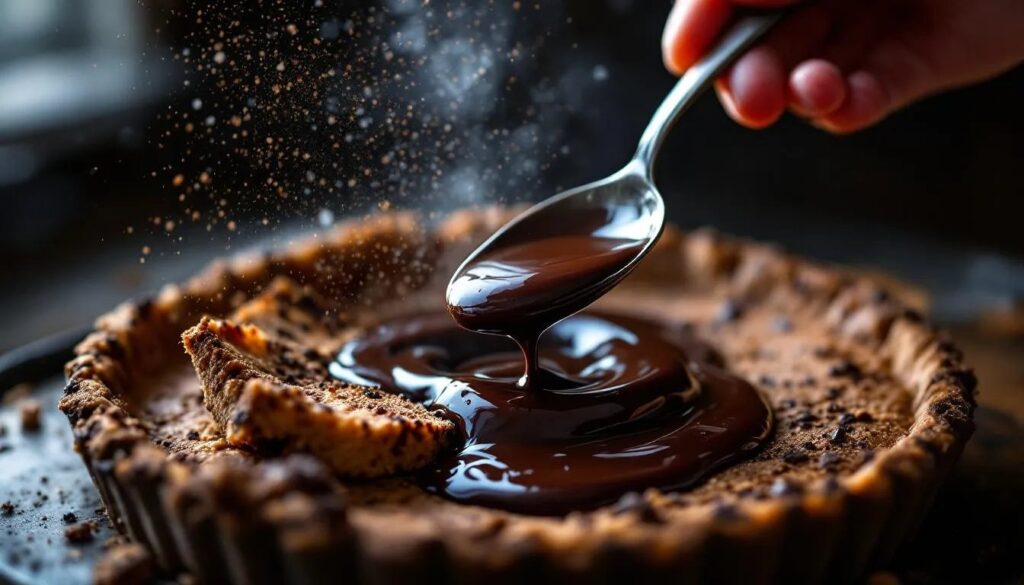
Spring arrives with a particular kind of craving — something dark, smooth, and just indulgent enough to mark the end of a long week. Easter weekend fills markets and kitchen windows with chocolate in every form, yet the most striking desserts often hide behind a reputation for complexity that simply does not hold up. A molten chocolate fondant, a silky marquise, a deep-set ganache tart — each one carries an air of professional precision that discourages home cooks before they even reach for a whisk. The truth is rather different.
This chocolate dessert relies on technique, not talent. The kind of technique that takes about fifteen minutes to understand and a lifetime to enjoy. What follows is a chocolate fondant — rich, barely set at its center, with a crust that yields to the spoon like dark velvet. It calls for five core ingredients, a handful of ramekins, and the kind of focused attention that any occasion in late March seems to deserve.
| Preparation | 15 min |
| Cooking | 11–12 min |
| Resting | 5 min |
| Portions | 4 people |
| Difficulty | Medium |
| Cost | €€ |
| Season | Spring · Easter chocolate · Year-round pantry staple |
Suitable for: Vegetarian · Naturally gluten-free (when using the recipe below)
Ingredients
- 200 g dark chocolate, minimum 70% cocoa solids
- 150 g unsalted butter, plus a little extra for greasing
- 4 whole eggs, at room temperature
- 2 egg yolks, at room temperature
- 150 g caster sugar
- 40 g plain flour (or rice flour for a fully gluten-free version)
- 1 pinch fine sea salt
- Unsweetened cocoa powder, for dusting the ramekins
Equipment
- 4 individual ramekins (approx. 150 ml capacity each)
- Heatproof mixing bowl
- Small saucepan for the bain-marie
- Electric hand whisk or stand mixer
- Rubber spatula
- Pastry brush
- Baking tray
- Kitchen timer (mandatory — precision matters here)
Method
1. Prepare the ramekins
Heat the oven to 200°C (fan 180°C / gas mark 6). Using a pastry brush, coat the inside of each ramekin generously with softened butter, working the brush in upward strokes rather than circles — this creates vertical lines that help the fondant rise evenly and release cleanly. Once buttered, dust each ramekin with unsweetened cocoa powder, tapping out any excess. The cocoa acts as a non-stick barrier while deepening the chocolate flavor at the outer crust. Place the prepared ramekins on a baking tray and refrigerate until needed.
2. Melt the chocolate and butter
Break the dark chocolate into even pieces and place them in a heatproof bowl along with the 150 g of unsalted butter, cut into cubes. Set the bowl over a saucepan of barely simmering water, ensuring the base of the bowl does not touch the water — this is the bain-marie method, which melts chocolate gently and prevents it from seizing or scorching. Stir occasionally with a rubber spatula until the mixture is completely smooth, glossy, and unified. Remove from the heat and allow to cool slightly for 3–4 minutes — you want it warm but not hot enough to scramble the eggs when combined.
3. Whisk the eggs and sugar
In a large mixing bowl, combine the whole eggs, egg yolks, and caster sugar. Whisk on high speed for 4–5 minutes until the mixture has more than doubled in volume, turned pale, and reaches the ribbon stage — meaning that when you lift the whisk, the batter falls back in a thick, slow ribbon that holds its shape on the surface for a few seconds before dissolving. This aeration is what gives the fondant its delicate outer shell while keeping the inside liquid and intense. Do not rush this step.
4. Combine and fold
Pour the warm chocolate and butter mixture into the egg mixture in a slow, steady stream, stirring gently with a spatula. Once roughly combined, sift over the flour and the pinch of salt, then fold everything together using broad, confident strokes from the bottom of the bowl upward. The goal is to incorporate the flour without deflating the batter — fold, do not stir. Stop the moment no dry streaks remain. The batter should look deeply glossy, like polished dark wood.
5. Fill and chill (or bake immediately)
Remove the ramekins from the refrigerator and divide the batter evenly among them, filling each to about three-quarters full. At this point, you have a choice: bake immediately, or cover with cling film and refrigerate for up to 24 hours — which makes this dessert genuinely practical for a dinner party. If baking from chilled, add 2 extra minutes to the cooking time.
6. Bake with precision
Place the baking tray in the center of the preheated oven and bake for exactly 11 minutes if baking from room temperature. The edges of each fondant should be set and pulling very slightly away from the ramekin walls; the center should still carry a distinct wobble — not a liquid slosh, but a slow, deliberate quiver when you gently shake the tray. Remove from the oven and rest for 5 minutes. This resting period is not optional: it allows the outer structure to firm just enough to hold during unmolding.
7. Turn out and serve
Run a thin-bladed knife around the edge of each ramekin, then place a warmed serving plate face-down on top and invert in one confident motion. Hold for three seconds, then lift the ramekin away. The fondant should stand upright, with a slightly domed, matte surface — the crust will have a gentle resistance when pressed with a spoon before giving way to the molten interior. Serve without delay: the liquid center begins to set within minutes.
Chef's tip
The quality of the chocolate defines everything in this recipe. With just five ingredients, there is nowhere for an inferior product to hide. Look for a bar that lists cocoa mass and cocoa butter as the first two ingredients, and choose one with a cocoa content between 70% and 75% — above 80% can tip into bitterness that overwhelms the texture. In spring, when Easter confectionery floods the shelves, single-origin bars from Madagascar or Ecuador are often more accessible and affordable than usual. A small flake of good sea salt pressed gently into the surface before baking draws the chocolate's fruit and bitterness into focus.
Dessert and drink pairings
A dessert built around dark chocolate at 70% carries flavors that move toward roasted coffee, dried cherry, and bitter orange — any pairing should either mirror or cleanly contrast those notes.
A glass of Banyuls from the Roussillon — a naturally sweet, fortified red wine with notes of dried fruit and cocoa — is the classic match and one that holds up beautifully. A Pedro Ximénez Sherry, poured cold, offers a more accessible alternative with its dense raisin and fig character. For a non-alcoholic option, a strong, lightly sweetened cold brew coffee with a small pour of oat milk cuts the richness cleanly and lets the chocolate speak.
A little history
The chocolate fondant as a concept occupies a peculiarly disputed corner of culinary history. French chef Michel Bras developed his version in the early 1980s — a composed dessert featuring a cold ganache center encased in warm chocolate cake, served in the Aubrac highlands of southern France. The dish was precise, considered, and technically demanding. What reached restaurant menus worldwide through the 1990s and 2000s was a simpler, more instinctive interpretation: a batter intentionally underbaked to preserve a liquid core, a technique that spread across bistros, brasseries, and eventually home kitchens.
The global version became shorthand for restaurant indulgence at the turn of the millennium — sometimes to the point of overexposure. What never changed was the underlying logic: dark chocolate, minimal starch, controlled heat, and the nerve to pull it from the oven while it still moves. In Britain and the United States, the dish is often called a lava cake; in France, it remains the fondant au chocolat or mi-cuit. The name varies; the wobble does not.
Approximate nutritional values (per serving)
| Nutrient | Amount |
|---|---|
| Calories | ~520 kcal |
| Protein | ~9 g |
| Carbohydrates | ~48 g |
| of which sugars | ~40 g |
| Fat | ~33 g |
| Saturated fat | ~19 g |
| Fiber | ~3 g |
Frequently asked questions
Can i prepare the fondants in advance?
Yes — and this is one of the genuine strengths of this recipe. Fill the ramekins, cover each one tightly with cling film, and refrigerate for up to 24 hours before baking. When cooking from cold, increase the baking time by 2 minutes (13 minutes total at 200°C). The batter also freezes well for up to one month; bake directly from frozen, adding 3–4 minutes to the original time.
How do i know when they are cooked correctly?
The outer rim of each fondant should look set and the surface should appear matte rather than glossy and liquid. When you gently shake the tray, the center should wobble with a slow, consistent movement — not splash. If the whole surface moves as one uniform mass, it needs another minute. If there is no movement at all, the center has set and the molten effect will be lost. A kitchen timer and a consistent oven are your two most important tools.
What substitutions work well?
For a fully gluten-free version, replace the plain flour with the same weight of rice flour — the texture is marginally more tender but the result is otherwise identical. Dairy-free versions can be made using a good-quality plant-based butter (block style, not spread) and a high-cocoa dairy-free chocolate; the flavor will be slightly less round but still distinct. Avoid replacing the eggs — they form the structural core of this dessert and cannot be substituted without a fundamental change to the recipe.
My fondants stuck to the ramekins. What went wrong?
The most common cause is insufficient or uneven buttering — any gap in the coating creates a point of adhesion. Use softened (not melted) butter and apply it in upward strokes with a pastry brush, then chill the ramekins before dusting with cocoa. A second thin coat of butter before filling adds extra insurance. If a fondant does stick, do not force it — slide a thin knife around the edge, wait 30 seconds, and try again with a firmer inversion.
Can i use milk chocolate instead of dark?
Technically yes, though the result changes considerably. Milk chocolate contains more sugar and dairy solids and melts at a lower temperature, which makes the center set faster in the oven. If using milk chocolate, reduce the baking time by 1–2 minutes and expect a sweeter, creamier, and less intense final flavor. For the most pronounced result at Easter — when quality dark chocolate is at its most available — stick with a 70% cocoa bar.