



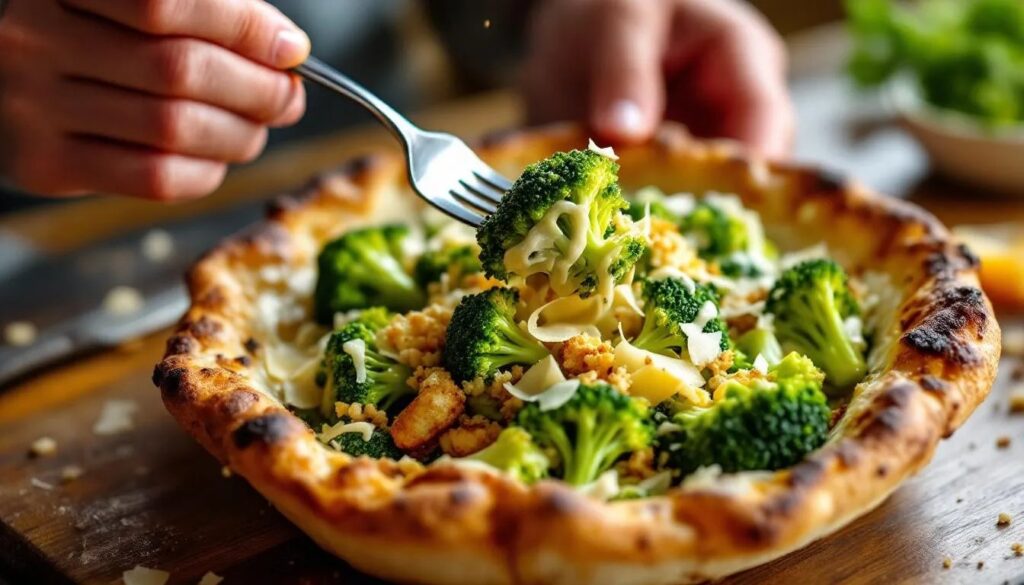
Late March brings that welcome shift at the market — the last of winter's hearty greens linger alongside the first shy signs of spring, and broccoli sits squarely at the center of it all. Still firm, still deeply verdant, still at its most flavorful before the warmer weeks soften its structure, this is the moment to celebrate it properly rather than relegate it to a side dish afterthought. A Caesar salad — that cult American classic with its punchy anchovy dressing, sharp Parmesan, and satisfying crunch — turns out to be one of the most compelling frameworks broccoli has ever been given. The combination is bold, slightly unexpected, and entirely logical once you taste it.
This version leans into the vegetable's natural bitterness, amplifying rather than masking it with a dressing built for backbone: egg yolk, garlic, Worcestershire, a good hit of lemon, and anchovies worked into a smooth, clinging emulsion that coats every floret. The broccoli is not raw, not fully cooked — it is blanched then shocked, a technique that keeps color vivid, texture snappy, and flavor concentrated. Homemade croutons fried in olive oil add the crunch the dish demands, and a generous snowfall of aged Parmesan ties the whole plate together. Time to put on the apron.
| Preparation | 20 min |
| Cooking | 15 min |
| Portions | 4 people |
| Difficulty | Easy |
| Cost | $$ |
| Season | Broccoli, lemon, flat-leaf parsley |
Suitable for: Vegetarian (omit anchovies) · Rich in protein · High in fiber
Ingredients
For the salad
- 1 large head broccoli (~700 g), cut into even florets, stem peeled and sliced into batons
- 100 g stale sourdough or country bread, torn into rough chunks
- 3 tbsp extra-virgin olive oil, for the croutons
- 50 g Parmesan, finely grated, plus extra shavings to serve
- Flaky sea salt and freshly ground black pepper
For the Caesar dressing
- 2 anchovy fillets in oil (plus 1 tsp of their oil)
- 1 small garlic clove, peeled
- 1 egg yolk, at room temperature
- 1 tbsp Dijon mustard
- 2 tbsp lemon juice, freshly squeezed (~½ lemon)
- 1 tsp Worcestershire sauce
- 80 ml neutral oil (sunflower or light vegetable)
- 2 tbsp extra-virgin olive oil
- 2 tbsp cold water, to loosen if needed
- 30 g Parmesan, finely grated
Equipment
- Large pot for blanching
- Large bowl filled with iced water (ice bath)
- Pestle and mortar, or a sharp knife and flat board
- Medium mixing bowl and a balloon whisk
- Large frying pan or skillet
- Colander
- Large serving bowl or platter
- Microplane or fine grater
Preparation
1. Build the ice bath and blanch the broccoli
Fill a large bowl with cold water and a generous amount of ice cubes — this ice bath is the step that separates vivid, snappy broccoli from the dull, limp version. Bring a large pot of well-salted water to a rolling boil; it should taste almost like the sea, which seasons the vegetable from the inside out. Drop the broccoli florets and stem batons into the boiling water and cook for exactly 2 minutes. You are not aiming for tenderness here — you want the broccoli to lose its raw starchiness while retaining firm resistance when bitten. The color will shift from pale to a startlingly vivid green, which is your visual cue. Drain immediately and plunge every piece into the ice bath. Leave for 3 minutes, then drain again thoroughly and spread on a clean kitchen towel to dry. Excess moisture is the enemy of a well-dressed salad.
2. Make the Caesar dressing
In a pestle and mortar, pound the anchovy fillets and garlic clove together with a small pinch of flaky salt until you have a smooth, pale paste — this is the aromatic base of the dressing and it should be completely homogeneous, with no visible chunks of anchovy. If you do not have a mortar, mince both very finely with a knife and use the flat of the blade to work the paste against the board. Transfer to a medium bowl and add the egg yolk, Dijon mustard, lemon juice, Worcestershire sauce, and the reserved teaspoon of anchovy oil. Whisk together until the mixture looks unified and slightly pale. Now comes the emulsification: the process of suspending oil droplets in a water-based liquid to create a stable, creamy sauce. Add the neutral oil in an extremely thin, slow, continuous stream — almost drop by drop at first — whisking constantly and vigorously. The dressing will thicken noticeably after the first few tablespoons of oil have been incorporated. Once it begins to hold, you can add the oil slightly faster. Finish with the olive oil, then stir in the grated Parmesan. Taste and adjust: it should be sharp, salty, and deeply savory. Thin with cold water, one tablespoon at a time, until it reaches a consistency that will coat a leaf or floret without pooling at the bottom of the bowl.
3. Fry the croutons
Heat the olive oil in a large frying pan over a medium-high flame until it shimmers. Add the torn bread pieces in a single layer — do not crowd the pan, or they will steam rather than fry. Leave them undisturbed for 90 seconds before turning; you want a deep golden crust on at least two sides. The sound should be a steady, confident sizzle. Season with flaky salt while still hot and transfer to a plate lined with kitchen paper. The croutons should be crisp all the way through, not just on the surface.
4. Dress and assemble
Place the dried broccoli in a large serving bowl. Spoon over roughly two-thirds of the dressing and toss to coat every surface — use your hands if you need to, working the dressing into the tight clusters of the florets where it tends to pool. Scatter over half the grated Parmesan and toss again. Taste a floret: it should be punchy and well-seasoned. Add the croutons and the remaining dressing in a final loose toss. Finish with Parmesan shavings, a few turns of black pepper, and serve immediately while the croutons still have their crunch.
Chef's tip
The dressing can be made up to 24 hours ahead and stored in a sealed jar in the refrigerator — it will actually improve overnight as the garlic mellows and the flavors knit together. Remove it from the fridge 15 minutes before using so it loosens back to a pourable consistency. For a richer, more substantial version in early spring, add a handful of soft-boiled quail eggs, halved, or a few white anchovy fillets laid across the top at the very end. If you prefer a milder garlic punch, blanch the raw clove in boiling water for 30 seconds before pounding — it softens the sharpness without eliminating the flavor.
Wine pairing
The Caesar dressing's combination of egg yolk richness, bright lemon acidity, and the fermented depth of anchovies and Worcestershire calls for a white wine with enough structure and body to stand its ground — nothing too delicate or aromatic, which would be overwhelmed by the salt and umami.
A white Burgundy such as a Mâcon-Villages or a village-level Chablis works particularly well: the mineral backbone of Chardonnay grown on limestone soils echoes the lemon in the dressing, while the wine's creamy mid-palate mirrors the emulsified richness of the sauce without fighting it. For a more accessible option, an unoaked or lightly oaked Chardonnay from the Languedoc offers similar structure at a lower price point. Those who prefer something with a little more grip might try a Vermentino from Sardinia, whose slight bitter finish aligns beautifully with broccoli's natural edge. For a non-alcoholic pairing, a sparkling water with a generous squeeze of lemon and a few drops of apple cider vinegar achieves a surprisingly similar effect on the palate.
About this dish
The Caesar salad was created in Tijuana, Mexico in the 1920s by Caesar Cardini, an Italian-born restaurateur who ran a popular establishment just across the US border — a location that allowed him to skirt Prohibition-era restrictions while serving American clientele. According to culinary lore, the original dressing was tableside theater: whole romaine leaves coated in a dressing of garlic, Worcestershire, lemon, olive oil, raw egg, and Parmesan, tossed with anchovy-rubbed croutons. Anchovies were not in Cardini's original formula but were quickly adopted as the recipe spread and evolved through American restaurant culture. The dish became one of the most replicated and adapted recipes of the twentieth century.
Substituting romaine for broccoli reflects a broader shift in how cooks now approach this dressing — not as a prescription tied to a single leaf but as a flavor system that performs brilliantly with vegetables that have structure, bitterness, and a surface area capable of holding an emulsified sauce. Cauliflower, shaved Brussels sprouts, and kale have all made convincing appearances in this role. Broccoli, particularly at the tail end of winter and into early spring when it is at its densest and most flavorful, may be the most satisfying of these alternatives. The dressing clings to every floret, the croutons catch in the crevices, and the result is a plate that feels simultaneously familiar and genuinely new.
Nutritional values (per serving, approximate values)
| Nutrient | Amount |
|---|---|
| Calories | ~410 kcal |
| Protein | ~16 g |
| Carbohydrates | ~22 g |
| of which sugars | ~4 g |
| Fat | ~30 g |
| Fiber | ~5 g |
Frequently asked questions
Can this salad be prepared in advance?
The components can all be prepared ahead, but the final assembly should happen just before serving. Blanch and dry the broccoli up to a day in advance and store it uncovered in the refrigerator — the air circulation actually helps it dry further, which improves dressing adhesion. Make the dressing up to 24 hours ahead. Fry the croutons a few hours early and keep them at room temperature, uncovered. Only toss everything together at the last moment to preserve the croutons' crunch.
How should leftovers be stored?
Once dressed, the salad does not hold well — the croutons soften and the dressing breaks down the broccoli's texture within a couple of hours. If you anticipate leftovers, keep the components separate and dress individual portions to order. Leftover dressing keeps in a sealed jar in the refrigerator for up to 3 days. Undressed blanched broccoli will keep refrigerated for 2 days.
What substitutions work well?
For a vegetarian version, replace the anchovies in the dressing with an equal quantity of white miso paste — it provides a comparable depth of umami and saltiness without any fish. Capers, finely minced, can also play a supporting role. For a dairy-free adaptation, nutritional yeast blended into the dressing approximates the savory, slightly nutty note that Parmesan contributes. In spring, as the season advances, Tenderstem broccoli works beautifully here and requires no blanching — a brief 3-minute turn in a very hot dry pan gives it char and smokiness that adds another dimension to the finished salad.
Is raw egg safe to use in the dressing?
The egg yolk in a classic Caesar dressing is used raw, which gives the emulsion its characteristic richness. For those concerned about food safety — including pregnant women, elderly individuals, or young children — a pasteurized egg yolk is the most straightforward solution. Alternatively, a tablespoon of mayonnaise (which is itself an egg yolk emulsion) can replace the raw yolk entirely, producing a dressing that is similarly creamy and stable. The lemon juice's acidity also plays a mild preservative role, but it does not fully denature the proteins in the yolk.
Can the broccoli be roasted instead of blanched?
Roasting the broccoli at 220°C for 18 to 20 minutes until the tips are charred and the stems are tender creates a fundamentally different but equally compelling dish. The flavor shifts from fresh and grassy to nutty and caramelized, which the Caesar dressing handles with ease — the acidity cuts through the char while the fat in the emulsion picks up the roasted flavor notes. Allow the roasted broccoli to cool to warm rather than hot before dressing, as heat will break the emulsion on contact.