

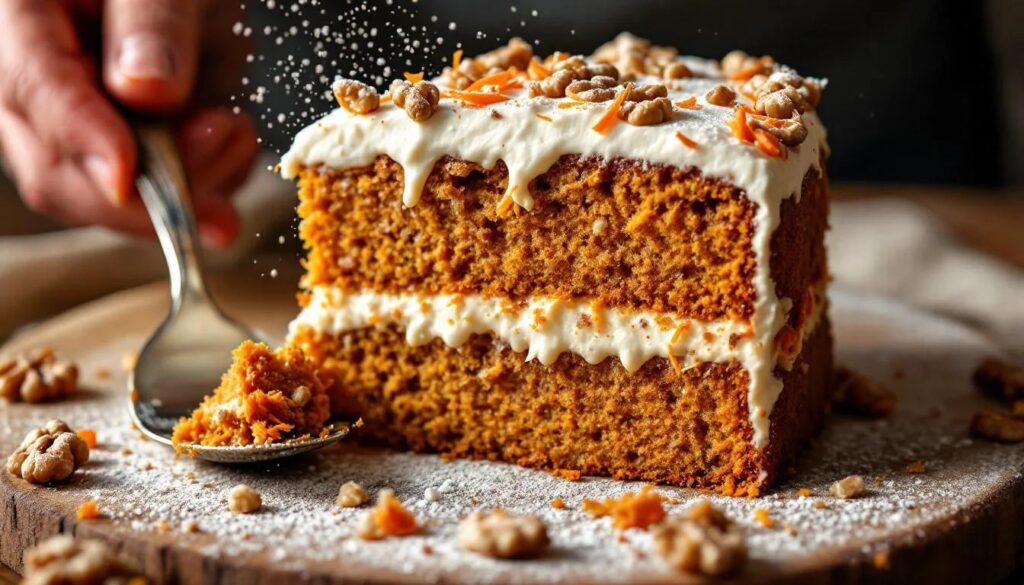
Spring calls for a carrot cake — and not just any version. As markets fill with the season's first bright-orange carrots, tender and sweet from cool soil, this is the moment to bake a cake that earns its place at the Easter table without demanding hours of effort or a sink full of washing-up. Greek yogurt steps in where butter once dominated, lending the batter a subtle tang and an almost impossibly moist crumb that keeps the cake fresh for days.
This one-bowl recipe strips away the complexity that keeps most people from baking mid-week. No stand mixer required. No creaming butter until your arm aches. Everything comes together in a single bowl, in under fifteen minutes of active preparation, producing a cake with a tender, densely spiced interior and a cream cheese frosting that clings to every furrow. Time to tie on that apron.
| Prep time | 15 min |
| Cook time | 40 min |
| Rest time | 20 min |
| Servings | 10 slices |
| Difficulty | Easy |
| Cost | $ |
| Season | Spring carrots, fresh walnuts |
Suitable for: Vegetarian
Ingredients
For the cake batter
- 3 large eggs, at room temperature
- ¾ cup (150 g) light brown sugar, packed
- ¼ cup (50 g) granulated sugar
- ½ cup (120 ml) neutral vegetable oil (sunflower or light olive oil)
- 1 cup (240 g) full-fat plain Greek yogurt
- 1 tsp pure vanilla extract
- 2 cups (260 g) all-purpose flour
- 1½ tsp baking powder
- ½ tsp baking soda
- ¼ tsp fine salt
- 2 tsp ground cinnamon
- ½ tsp ground ginger
- ¼ tsp freshly grated nutmeg
- 2 cups (220 g) freshly grated carrot (about 3 medium carrots)
- ½ cup (60 g) walnuts, roughly chopped (optional)
For the cream cheese frosting
- 8 oz (225 g) full-fat cream cheese, softened
- 1½ cups (180 g) powdered sugar, sifted
- 1 tsp pure vanilla extract
- 2–3 tbsp heavy cream or whole milk, as needed
Equipment
- One large mixing bowl
- Box grater or food processor with grating attachment
- Whisk
- Rubber spatula
- 9-inch (23 cm) round cake pan or 9×9-inch (23×23 cm) square pan
- Parchment paper
- Wire cooling rack
- Hand mixer or stand mixer (for the frosting only)
- Offset spatula or butter knife
Preparation
1. Set up your oven and pan
Preheat your oven to 350°F (175°C), positioning the rack in the center. Grease your cake pan thoroughly with a thin layer of butter or cooking spray, then line the base with a round of parchment paper. Lining the bottom is not optional — the yogurt and grated carrot create a batter that wants to cling, and a clean release makes all the difference when you unmold the cake later. Set the pan aside while you prepare the batter; a cold pan going into a hot oven produces a better initial rise.
2. Grate the carrots
Peel your carrots and grate them on the fine side of a box grater, or use the fine grating disc of a food processor. Freshly grated carrot is non-negotiable here — pre-shredded bagged carrot is too dry and too coarse, and it will not melt into the crumb the way fine carrot does. Spring carrots, slender and just-pulled, tend to be naturally sweeter and more tender than winter storage carrots, so if you can source them at a farmers' market this time of year, use them. You should end up with approximately 2 loosely packed cups. Set aside.
3. Mix the wet ingredients
In your large mixing bowl, whisk together the eggs, brown sugar, and granulated sugar until the mixture looks slightly lighter in color and the sugars have begun to dissolve — about 60 to 90 seconds of active whisking. Add the oil and whisk again until fully incorporated; the mixture will take on a glossy, cohesive look. Spoon in the Greek yogurt and the vanilla extract and whisk until smooth. The yogurt may resist slightly at first, but a vigorous whisk will bring everything into a single, creamy emulsion. This wet base is what guarantees the cake's characteristically moist interior — the proteins and fat in full-fat yogurt form a tighter network than buttermilk, keeping the crumb dense without making it heavy.
4. Add the dry ingredients
Sprinkle the flour, baking powder, baking soda, salt, cinnamon, ginger, and nutmeg directly over the wet ingredients. Switch from your whisk to a rubber spatula. Fold — a technique of cutting down through the center of the batter, sweeping along the bottom of the bowl, and lifting the mixture over itself — rather than stir. Folding limits gluten development, the chain of elastic proteins that forms when flour is aggressively worked in liquid. Overdeveloped gluten means a tough cake. Stop folding as soon as you can no longer see dry streaks of flour; a few small lumps are perfectly acceptable and will bake out.
5. Fold in the carrots and walnuts
Add the grated carrot and the chopped walnuts to the batter. Fold gently, again using the rubber spatula, until the carrot is evenly distributed throughout. The batter will thicken visibly as the carrot releases some of its moisture and integrates — this is expected. The mix should be thick enough to fall from the spatula in slow, heavy ribbons. If you are leaving out the walnuts, the batter needs the same gentle fold; do not compensate by adding more flour.
6. Bake the cake
Pour and scrape the batter into your prepared pan, smoothing the surface with the back of the spatula so the batter reaches the edges evenly. Bake in the center of the preheated oven for 35 to 42 minutes, depending on your oven. The cake is done when the surface is a deep amber brown, the edges have pulled away very slightly from the pan, and a wooden toothpick inserted into the thickest part of the center comes out with just a few moist crumbs clinging to it — no wet batter. Avoid opening the oven door before the 30-minute mark, as the sudden drop in temperature can cause the center to sink before the structure has set. Place the pan on a wire rack and allow the cake to cool in the pan for 10 minutes before turning it out. Leave it to cool completely on the rack — at least a further 20 minutes — before applying any frosting.
7. Make the cream cheese frosting
Using a hand mixer or stand mixer fitted with the paddle attachment, beat the softened cream cheese on medium speed for about 2 minutes until it is completely smooth and free of lumps. Cream cheese that is not fully at room temperature will leave small cold pockets in the frosting — take it out of the refrigerator at least 30 minutes before you begin. Add the sifted powdered sugar in two additions, beating on low speed at first to prevent a cloud of sugar, then increasing to medium. Mix in the vanilla extract. Add heavy cream or milk one tablespoon at a time until the frosting reaches a consistency that holds its shape but spreads with ease — it should look like thick whipped cream, not liquid glaze. Taste and adjust: a small pinch of salt can sharpen the flavor significantly.
8. Frost and finish
Place the fully cooled cake on a flat serving plate. Spoon the frosting onto the center and use an offset spatula or the back of a large spoon to spread it outward toward the edges, letting it fall and drape naturally over the sides if you like a relaxed, informal look. For a cleaner finish, keep the frosting on top only. If using, scatter a few extra walnut pieces or a dusting of cinnamon across the frosted surface. Give the cake at least 10 minutes after frosting before slicing, which allows the topping to settle into the crumb.
Chef's tip
The single most impactful thing you can do for this batter is to grate the carrots immediately before mixing — not the night before, not an hour before. Freshly grated carrot retains its moisture inside the cake during baking, steaming gently from within and producing that signature tender crumb. Carrot that has been sitting uncovered loses that surface moisture to evaporation and compensates by drawing liquid from the batter instead, which can leave the finished cake slightly drier in the center. In early spring, when young carrots are slim and thin-skinned, there is no need to peel them at all — a good scrub under cold water is sufficient, and the skins contribute a touch of earthiness that rounds out the spice profile.
Drink pairings
The cream cheese frosting carries a bright acidity that pairs best with drinks that either echo or contrast that tang without adding sweetness on sweetness. The warm spice from the cinnamon and ginger calls for something aromatic but clean on the finish.
A late-harvest Riesling from Alsace or the Mosel — with its honeyed stone-fruit character and brisk natural acidity — stands up to the richness of the frosting and flatters the carrot's sweetness without overwhelming it. A lightly effervescent pét-nat from the Loire, made from Chenin Blanc, is a lighter, more festive option for a spring table. For a non-alcoholic choice, a well-steeped masala chai with milk, or a cold-brewed cinnamon-and-cardamom tea, mirrors the spice notes in the cake while cleansing the palate between bites.
About this cake
Carrot cake as we know it today — moist, spiced, crowned with cream cheese frosting — became a fixture of American and British home baking during the 1960s and 1970s, partly driven by an interest in using vegetables in baking as a way to add moisture and cut back on refined fat. However, the idea of sweetening baked goods with carrot is far older: medieval European recipes used carrot as a sugar substitute at a time when cane sugar was expensive and scarce, producing dense, naturally sweet puddings that bear little resemblance to the towering layer cakes of today. The cream cheese frosting, now considered inseparable from the cake, is largely an American innovation, popularized as cream cheese became widely available in the mid-twentieth century.
Greek yogurt in place of oil or buttermilk is a more recent adaptation, driven by the broader shift toward fermented dairy in baking. The swap reduces the overall fat content slightly while introducing lactic acid, which reacts with the baking soda to produce additional lift, and contributes a flavor complexity — a faint sour note — that plain oil simply cannot replicate. The one-bowl method, stripping away the separate creaming and folding steps of a classic layer cake, makes this version genuinely accessible on a weeknight, without compromising the finished texture.
Nutritional values (per slice, approximate values)
| Nutrient | Amount |
|---|---|
| Calories | ~360 kcal |
| Protein | ~7 g |
| Carbohydrates | ~44 g |
| of which sugars | ~28 g |
| Fat | ~17 g |
| Fiber | ~2 g |
Frequently asked questions
Can this cake be made ahead of time?
Yes, and it actually improves with a night's rest. The spices deepen and the crumb becomes more uniform in texture as it sits. Bake the cake, allow it to cool completely, wrap it tightly in plastic wrap without the frosting, and store it at room temperature for up to 24 hours or in the refrigerator for up to 3 days. Make and apply the cream cheese frosting on the day you plan to serve it, or store the frosted cake covered in the refrigerator and bring it to room temperature for 20 minutes before slicing.
How should leftovers be stored?
Once frosted, the cake must be refrigerated because of the cream cheese. Cover it loosely with plastic wrap or place it in an airtight cake container and refrigerate for up to 4 days. Individual slices can also be wrapped and frozen for up to 2 months — thaw overnight in the refrigerator, then bring to room temperature before eating. The texture of the crumb holds very well through freezing, though the frosting may weep slightly on thawing; blot gently with a paper towel before serving.
What substitutions are possible?
The Greek yogurt can be replaced with an equal weight of sour cream or labneh for a similarly tangy, thick result. For a dairy-free version, use a thick coconut-based yogurt and a vegan cream cheese for the frosting. The all-purpose flour can be swapped one-for-one with a good-quality gluten-free baking blend that contains xanthan gum. In summer, finely grated zucchini (squeezed dry in a clean towel) replaces the carrot with surprising success, producing an equally moist crumb with a more neutral flavor that lets the warm spices lead. Crushed pineapple — drained thoroughly — is a classic American addition; fold in ½ cup alongside the carrot for an extra layer of sweetness and acidity.
Why is my cake sinking in the center?
A sunken center usually points to one of three causes: the oven door was opened before the batter had time to set its structure (before the 30-minute mark), the baking powder or baking soda was past its expiration date and underpowered, or the batter was overmixed after the flour was added, which can create a dense center that cannot fully rise and support its own weight. Test your leaveners before baking by dropping a small spoonful of baking powder into hot water — it should bubble vigorously. If it doesn't, replace the tin.
Can this recipe be scaled to make a two-layer cake?
Easily. Double the batter quantities and divide the mixture evenly between two 9-inch (23 cm) round pans, both lined with parchment. Bake at the same temperature, checking at 30 minutes since the thinner layers will cook faster than a single deep pan. Cool both layers completely before assembling. Spread a generous layer of frosting over the first round, place the second directly on top, then frost the top and sides. The double batch of frosting recipe is exactly sufficient for a fully covered layer cake.