

Chicken breasts have a reputation problem. They're often seen as too dry, too bland, too forgiving of a bad cook and too punishing of an inattentive one. Most home kitchens have quietly given up on them in favor of thighs, drumsticks, or anything else that doesn't turn rubbery the moment you look away. As spring arrives, the days stretch out, and lighter proteins come back to the table, a well-executed chicken breast stops being a compromise and becomes something worth talking about.
Ina Garten, the beloved cookbook author and former host of Barefoot Contessa on Food Network, has spent decades proving that simple food done correctly is the only food worth making. Her approach to chicken breasts isn't a gimmick or a shortcut. It's a method grounded in heat control, resting time, and a handful of pantry staples that transform the most neglected cut of the bird into something genuinely satisfying. If you've written off chicken breasts, this recipe asks you to reconsider. Tie on your apron and give it one more chance.
| Preparation | 10 min |
| Cooking | 35 min |
| Resting | 10 min |
| Servings | 4 people |
| Difficulty | Easy |
| Cost | $$ |
| Season | Year-round — particularly good in spring with fresh herbs |
Suitable for: Gluten-free · High protein · Dairy-free
Ingredients
- 4 bone-in, skin-on chicken breasts (~10–12 oz each), at room temperature
- 2 tablespoons good olive oil
- 1½ teaspoons kosher salt
- ¾ teaspoon freshly ground black pepper
- 1 lemon, zested and halved
- 4 cloves garlic, minced
- 1 tablespoon fresh thyme leaves (or 1 teaspoon dried)
- 1 tablespoon fresh rosemary, finely chopped
- 2 teaspoons Dijon mustard
Equipment
- Oven-safe roasting pan or heavy sheet pan
- Instant-read meat thermometer
- Small mixing bowl
- Pastry brush or the back of a spoon
- Aluminum foil (for resting)
- Sharp chef's knife and cutting board
Preparation
1. Bring the chicken to room temperature and preheat the oven
Remove the chicken breasts from the refrigerator at least 30 minutes before cooking. This step is non-negotiable and it's the first thing most recipes skip over. Cold meat dropped into a hot oven seizes on the outside while the interior struggles to catch up, which is precisely how you end up with overcooked edges and an underdone center. While the chicken rests on the counter, preheat your oven to 350°F (175°C). Ina Garten is firm about this temperature — it sounds low compared to the blast-heat approach many cooks default to, but that moderate heat is what allows the interior of a thick breast to cook through evenly without the outside drying out.
2. Make the herb and lemon rub
In a small bowl, combine the olive oil, minced garlic, lemon zest, thyme, rosemary, Dijon mustard, salt, and pepper. Use a fork to work everything together into a rough paste. The Dijon here isn't about flavor dominance — it acts as an emulsifier, helping the oil and aromatics bind together and cling to the surface of the chicken rather than sliding off during roasting. Taste the paste before applying it; it should be assertively seasoned, almost aggressively so. Once it's on the chicken, the salt will draw out a small amount of moisture and then reabsorb, seasoning the meat from the surface inward.
3. Season the chicken thoroughly
Pat the chicken breasts completely dry with paper towels. Dry skin crisps; wet skin steams — the difference shows up clearly on the plate. Using your fingers or a pastry brush, spread the herb rub over the top and sides of each breast, working it gently under the skin wherever you can without tearing it. The skin acts as a natural basting mechanism, protecting the meat and basking it in rendered fat throughout cooking. Arrange the breasts skin-side up in your roasting pan, and squeeze the juice of half the lemon over everything. The remaining lemon half can go into the pan alongside the chicken, cut-side down — it will caramelize gently and add a subtle, rounded citrus note to any pan juices.
4. Roast low and slow, then check the temperature
Slide the pan onto the center rack and roast for 35 to 40 minutes, depending on the size of the breasts. Do not open the oven door repeatedly. Do not pour water into the pan. Do not baste obsessively. The oven is doing its work; trust the temperature. Around the 30-minute mark, begin checking with an instant-read thermometer inserted into the thickest part of the breast, away from the bone. You are looking for 165°F (74°C) — the USDA-recommended safe internal temperature for poultry. Pull the chicken at exactly this point. If you go to 170°F or beyond, the proteins have contracted too tightly and no amount of resting will bring the moisture back.
5. Rest the chicken before slicing
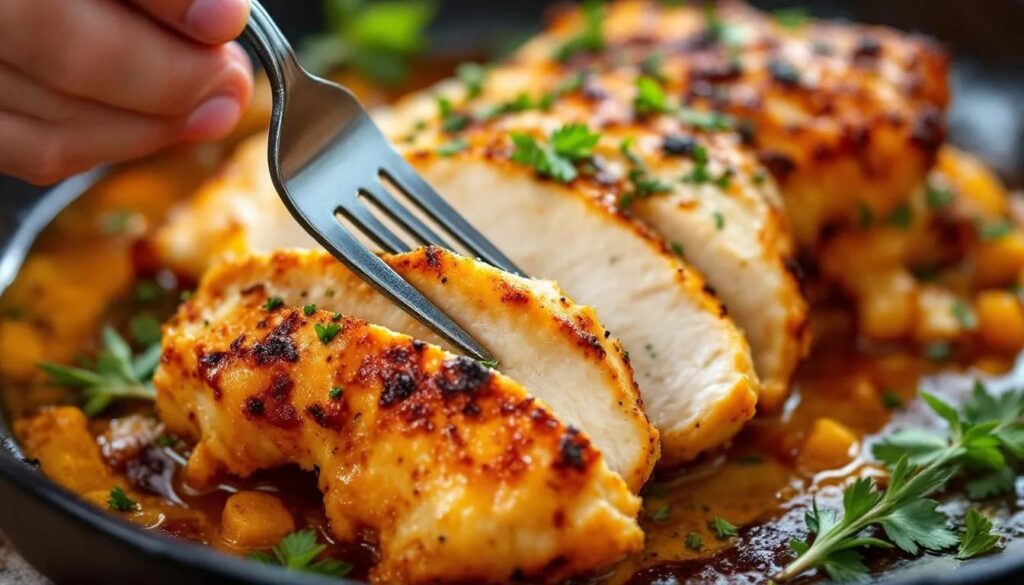
Transfer the chicken to a cutting board and tent loosely with aluminum foil. Rest for at least 10 minutes. This step is where the payoff happens: the residual heat continues gently cooking the meat while the muscle fibers relax and the juices, which have been pushed toward the center by the heat, redistribute evenly throughout. Slice too early and those juices run straight onto the board. Wait the full 10 minutes and every cut will be visibly moist. Serve the chicken whole or slice it on the diagonal for presentation, spooning any pan drippings over the top.
Chef's tip
The single biggest upgrade you can make to this recipe is buying bone-in, skin-on breasts rather than the boneless, skinless version that crowds most supermarket shelves. The bone conducts heat into the center of the meat while the skin renders and self-bastes throughout cooking — two structural features that a boneless breast simply cannot replicate. In spring, when fresh herbs start appearing at farmers markets, swap the dried thyme for a generous handful of fresh lemon thyme and add a few sprigs of fresh tarragon to the roasting pan. The flavor shift is remarkable, and it costs almost nothing extra.
Wine pairings
The roasted chicken's herbal character — thyme, rosemary, lemon zest — calls for a white wine with enough body to match the richness of the skin but enough acidity to cut through it cleanly.
A white Burgundy or a good Mâcon-Villages from France will work with particular elegance here: think ripe pear, a thread of minerality, and a finish that echoes the lemon in the dish. A California Chardonnay with moderate oak is a confident alternative. For those skipping alcohol, a sparkling water with a long slice of lemon and a sprig of fresh thyme mirrors the brightness of the dish without competing with it.
About this dish
Ina Garten has been writing about and teaching this style of roasted chicken for decades, and the consistency of her approach across multiple cookbooks — from Barefoot Contessa at Home to Modern Comfort Food — reflects a deep understanding of what home cooks actually struggle with. Her recipes are not chef's recipes translated for the home kitchen; they are built from the ground up for domestic ovens, standard supermarket ingredients, and the reality that most people cook after a full workday.
The method she uses for chicken breasts draws from classic French rôtisserie principles: room-temperature meat, a moderate oven, aromatic fat, and patient resting. What makes her version particularly accessible is that she strips the technique down to its irreducible essentials. No brining, no butterflying, no sous-vide. Just heat, timing, and a willingness to read a thermometer rather than guessing. It's an approach that works in any season, but in spring — when the kitchen starts to feel less like a refuge from cold and more like a place of actual pleasure — there's something particularly satisfying about mastering something this fundamental.
Nutrition facts (per serving, approximate values)
| Nutrient | Amount |
|---|---|
| Calories | ~420 kcal |
| Protein | ~52 g |
| Carbohydrates | ~3 g |
| of which sugars | ~0.5 g |
| Fat | ~21 g |
| Fiber | ~0.5 g |
Frequently asked questions
Can I use boneless, skinless chicken breasts instead?
You can, but the result will be noticeably different. Without the bone and skin, the breasts will cook faster — reduce the oven time to roughly 22 to 25 minutes and check the temperature early. The meat will also be leaner and drier, so consider basting it once halfway through with the pan juices or a little additional olive oil. The herb rub still does good work, but the self-basting quality of the skin-on version is lost.
Can I prepare this ahead of time?
The herb rub can be applied to the chicken up to 24 hours in advance. Cover the pan tightly with plastic wrap and refrigerate. The extended contact time actually deepens the flavor of the seasoning. Pull the pan out 30 minutes before cooking to let the meat return to room temperature, then proceed exactly as the recipe describes.
How do I store and reheat leftovers?
Store leftover chicken in an airtight container in the refrigerator for up to 3 days. To reheat without drying the meat out further, place the pieces in a baking dish, add a splash of chicken stock or water, cover tightly with foil, and warm in a 300°F (150°C) oven for 15 to 20 minutes. Avoid the microwave if you can — the uneven heat accelerates moisture loss and toughens the proteins quickly.
What sides work well with this recipe?
In spring, roasted asparagus dressed with olive oil and flaky salt is the natural companion — it can go into the oven alongside the chicken for the last 15 minutes. A simple green salad with shaved radishes and a lemon vinaigrette echoes the citrus notes in the rub. For something more substantial, a loose purée of white beans with garlic and olive oil provides texture contrast without overwhelming the chicken's herbaceous character.
Why does my chicken breast always come out dry, even when I follow a recipe?
The most common cause is overcooking past the 165°F threshold, often because the oven runs hotter than its dial suggests. Invest in an oven thermometer — many domestic ovens are off by 25°F or more in either direction. The second most common cause is skipping the resting step: slicing immediately after cooking releases the accumulated juices onto the cutting board rather than back into the meat. Ten minutes of resting is not optional; it's structural to the result.