

As March draws to a close and the first warmth of spring filters through kitchen windows, root vegetables are still pulling their weight at the market — and carrots are at their finest. Firm, sweet, and full of earthy depth after a winter in the ground, they reach their peak just as the season tips toward lighter cooking. Roasting them is the simplest way to coax out their natural sugars: the heat of the oven caramelizes their edges, deepens their color from pale orange to burnished amber, and concentrates every bit of flavor into something far more complex than a raw carrot could ever hint at.
What makes this recipe stand out is the harissa vinaigrette — a North African-inspired dressing that brings heat, smoke, and a bright acidic edge to the sweetness of the carrots. It is not a traditional combination, but it is a precise one: the spice cuts through the richness, the acidity lifts the whole dish, and the result sits comfortably between a warm side and a standalone salad. This is the kind of cooking that asks very little of your time and rewards you with something that tastes considered. Preheat the oven and reach for your roasting pan.
| Preparation | 10 min |
| Cooking | 40 min |
| Portions | 4 people |
| Difficulty | Easy |
| Cost | $ |
| Season | Carrots, spring herbs, lemon |
Suitable for: Vegan · Vegetarian · Gluten-free · Dairy-free
Ingredients
For the roasted carrots
- 2 lbs carrots, scrubbed and halved lengthwise (about 10–12 medium carrots)
- 2 tbsp olive oil
- ½ tsp fine sea salt
- ¼ tsp black pepper, freshly ground
- ½ tsp ground cumin
For the harissa vinaigrette
- 2 tbsp harissa paste (rose harissa or classic, depending on heat preference)
- 2 tbsp red wine vinegar
- 1 tbsp honey (or maple syrup for a fully vegan version)
- 3 tbsp extra-virgin olive oil
- 1 small garlic clove, finely grated
- ½ tsp fine sea salt
- 2 tbsp cold water to loosen, as needed
To finish
- A small handful of fresh cilantro or flat-leaf parsley, roughly torn
- 2 tbsp toasted sesame seeds or chopped toasted pistachios
- 1 tbsp pomegranate molasses (optional, for depth)
Equipment
- Large rimmed baking sheet
- Parchment paper
- Small mixing bowl or jar with lid
- Whisk or fork
- Vegetable brush or peeler
- Sharp chef's knife and cutting board
- Tongs or a wide spatula
Preparation
1. Preparing and seasoning the carrots
Preheat your oven to 425°F (220°C) with the rack positioned in the center. Line a large rimmed baking sheet with parchment paper — this prevents sticking and makes cleanup easier without sacrificing the caramelization on the underside of the carrots. If your carrots are fresh from the market, a good scrub is all they need; peeling is optional but gives a slightly cleaner finish. Halve them lengthwise so each piece has one flat side to press against the hot sheet — this direct contact is what drives the Maillard reaction, the chemical browning process that produces those deeply flavored, slightly charred edges. Place the halved carrots in a large bowl and toss with olive oil, salt, pepper, and ground cumin until every surface is lightly coated. Spread them in a single layer on the prepared sheet, cut side down, without overlapping — crowding the pan traps steam and prevents roasting, leaving you with soft, pale carrots instead of golden ones.
2. Roasting to caramelized depth
Slide the baking sheet into the preheated oven and roast for 35 to 40 minutes, without touching or stirring for the first 25 minutes. This patience is important: moving the carrots too soon tears them away from the caramelization building on their cut surface. After 25 minutes, use tongs to check the underside of one carrot — you are looking for a deep golden color with edges that are beginning to darken and curl slightly. If the color is not there yet, give them another 5 minutes. Flip the carrots and roast for the final 10 to 15 minutes until the flesh is tender when pierced with the tip of a knife and the surfaces are glossy and burnished. The natural sugars in the carrot will have reduced and concentrated, and the kitchen should smell of warm, sweet earth and toasted spice.
3. Making the harissa vinaigrette
While the carrots finish in the oven, prepare the vinaigrette. In a small bowl, combine the harissa paste, red wine vinegar, honey, and finely grated garlic. Whisk together briefly, then add the extra-virgin olive oil in a slow, steady stream while continuing to whisk — this creates a loose emulsification, meaning the oil and water-based components are temporarily brought together into a cohesive, pourable sauce rather than separating immediately. Season with salt and taste. The vinaigrette should hit all four points: heat from the harissa, brightness from the vinegar, sweetness from the honey, and richness from the oil. If it feels too thick, add cold water a tablespoon at a time until it reaches a consistency that coats a spoon but still flows freely.
4. Assembling and finishing the dish
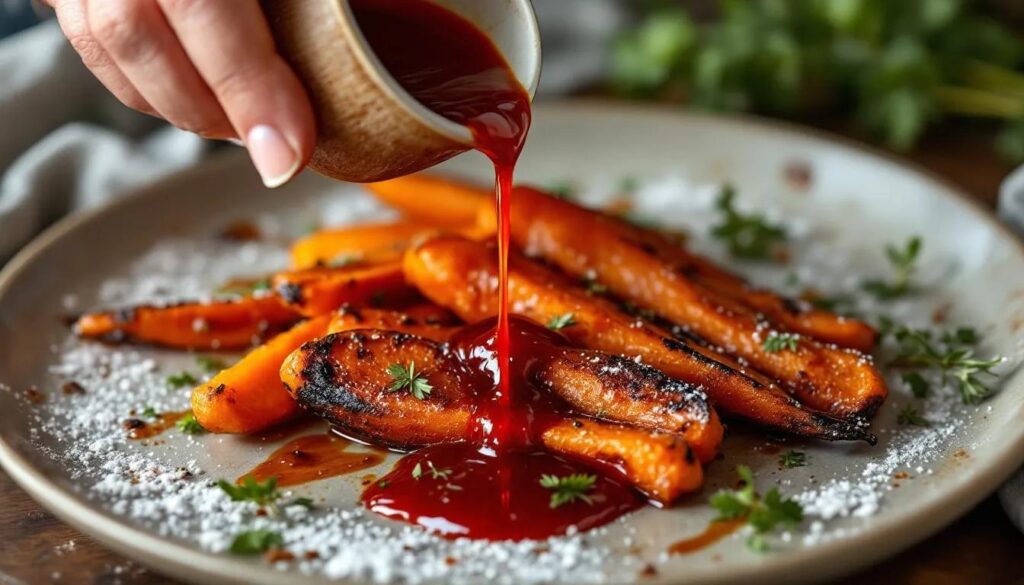
Transfer the hot roasted carrots to a serving platter, arranging them loosely so each piece is visible. Spoon the harissa vinaigrette generously over the top while the carrots are still warm — heat helps the dressing penetrate slightly rather than simply sitting on the surface. If you are using pomegranate molasses, drizzle it sparingly across the finished dish; it adds a dark, tart complexity that deepens the overall flavor without overpowering the harissa. Scatter the torn herbs over the top — cilantro brings a citrusy freshness, while parsley is more neutral and slightly peppery, both work — and finish with the toasted sesame seeds or pistachios for crunch and a subtle nuttiness. Serve immediately while warm, or at room temperature within an hour.
Chef's tip
The sweetness of carrots varies significantly depending on the variety and how recently they were harvested. In early spring, look for bunched carrots with their tops still on at the farmers' market — they tend to be younger, thinner, and sweeter than the large bag carrots that have been in storage since autumn. If your carrots are particularly large or thick, cut them into quarters lengthwise rather than halves to ensure even roasting throughout. For the harissa vinaigrette, the quality of the paste matters: a jarred harissa made with sun-dried peppers and caraway seeds will produce a far more layered result than a tube of generic chili paste. Rose harissa, made with rose petals, adds a floral undercurrent that works beautifully against the sweetness of the roasted carrot.
Wine and drink pairings
The combination of sweet roasted vegetable, smoky spice, and sharp acid in this dish calls for a wine with enough body to hold its ground without overwhelming the relatively delicate carrot.
A dry rosé from Provence — with its notes of dried red fruit, garrigue, and a clean mineral finish — handles the harissa's heat and the vinaigrette's acidity with ease. An orange wine, such as a skin-contact Grenache Blanc from the Languedoc, offers a more adventurous pairing with tannin structure that mirrors the earthiness of the spice blend. For those avoiding alcohol, a lightly sparkling water infused with cucumber and a squeeze of lemon cleanses the palate between bites and keeps the heat from building.
About this dish
Harissa originates in North Africa, with Tunisia most often credited as its home. The paste — made from roasted red peppers, dried chilis, caraway, coriander, garlic, and olive oil — has been a staple of Maghrebi cooking for centuries, used as a condiment, a cooking base, and a table sauce. Its migration into Western home kitchens and restaurant menus accelerated significantly over the past decade, driven in part by a broader appetite for bold, spiced vegetable cooking and plant-forward menus that demand more from pantry staples.
Using harissa as the base of a vinaigrette rather than a traditional marinade or dipping sauce is a relatively modern technique, one that bridges North African flavor profiles with the European tradition of dressed salads and roasted vegetable platters. The result occupies an interesting culinary space — familiar enough to feel approachable, distinct enough to feel new. Roasted carrot dishes of this style appear frequently in contemporary Middle Eastern and Mediterranean cooking, where the vegetable is treated as a primary ingredient rather than a supporting one.
Nutritional values (per serving, approximate values)
| Nutrient | Amount |
|---|---|
| Calories | ~210 kcal |
| Protein | ~2 g |
| Carbohydrates | ~22 g |
| of which sugars | ~13 g |
| Fat | ~13 g |
| Fiber | ~5 g |
Frequently asked questions
Can this dish be prepared in advance?
The carrots can be roasted up to 24 hours ahead and stored in an airtight container in the refrigerator. The harissa vinaigrette keeps well in a sealed jar for up to 5 days. To serve, bring the carrots to room temperature or reheat briefly in a 350°F (175°C) oven for 8 to 10 minutes, then dress just before plating. Adding the vinaigrette while the carrots are still warm gives the best result.
How should leftovers be stored?
Once dressed, the dish is best eaten within a few hours, as the vinaigrette softens the carrot's roasted exterior over time. Undressed leftovers keep in the refrigerator for up to 3 days and can be repurposed as a filling for grain bowls, stirred through couscous, or served alongside roasted chicken or a fried egg.
What substitutions can be made?
If harissa is unavailable, a combination of 1 tablespoon of tomato paste, ½ teaspoon of smoked paprika, and a pinch of cayenne will approximate the flavor profile, though without the complexity of the real thing. Red wine vinegar can be replaced with sherry vinegar for a slightly nuttier edge, or with lemon juice for a brighter, fresher result — particularly appropriate in spring. Honey can be substituted with maple syrup or agave to keep the dish fully vegan.
Can other vegetables be roasted the same way?
The same method and vinaigrette work well with parsnips, beets, sweet potatoes, and cauliflower. In spring, a mix of small new carrots and baby turnips roasted together makes a particularly seasonal variation. Adjust the roasting time based on the size and density of the vegetable — denser roots like beets will need closer to 50 to 55 minutes, while cauliflower florets will be ready in 25 to 30 minutes at the same temperature.
Is this dish served hot or cold?
Warm is ideal, and the vinaigrette should be added while the carrots are still hot from the oven. That said, this dish holds up exceptionally well at room temperature, making it well suited for a buffet table, a dinner party side, or a packed lunch. Avoid serving it straight from the refrigerator, as cold dulls the spice and mutes the caramelized flavor of the carrots.